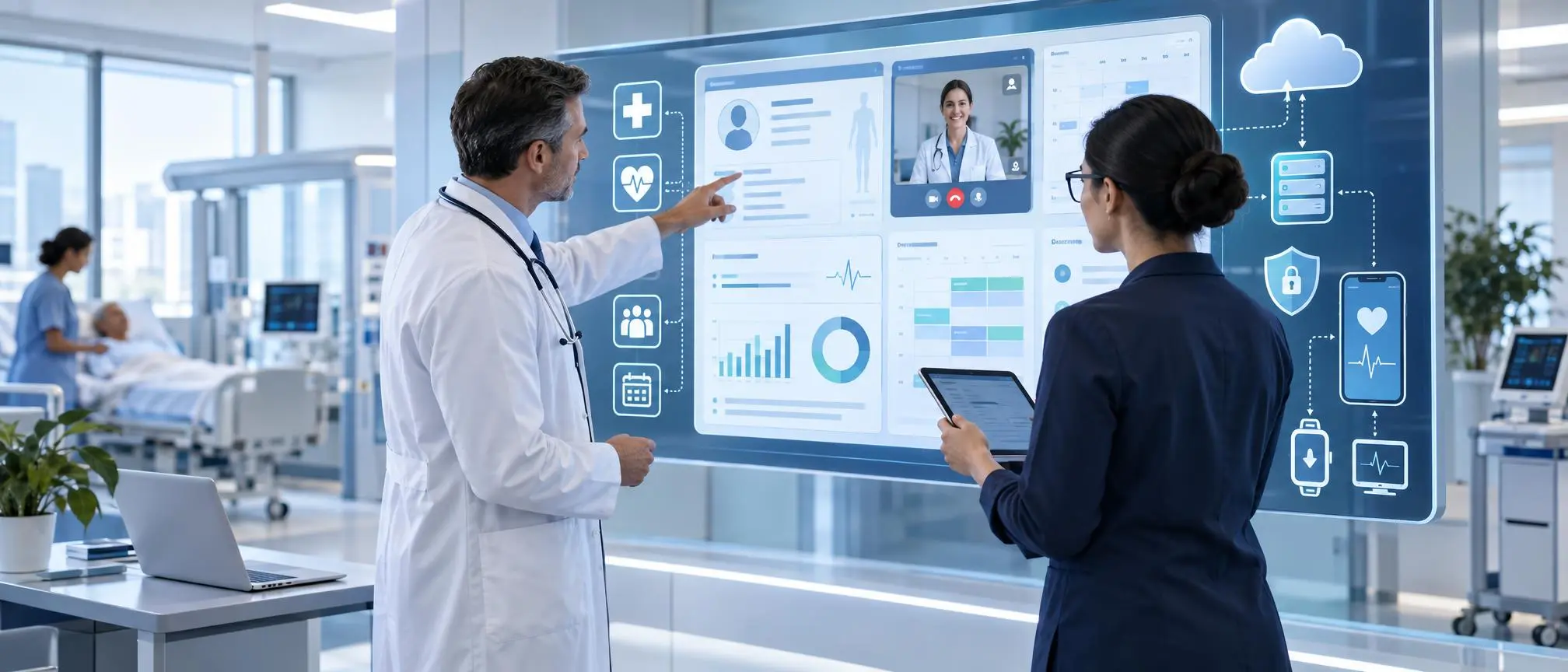

The landscape of the healthcare industry is changing. The digital transformation taking place within other industries is also happening in the world of healthcare. Healthcare organizations are utilizing digital solutions to perform services ranging from online appointment scheduling to remote patient monitoring and diagnostics.
While there are off-the-shelf software applications available for healthcare organizations, there are often challenges associated with the use of these applications. This is especially the case for an organization that has unique requirements and workflows. The organization may have to compromise its processes to adapt to the software.
There are a host of reasons why it may be beneficial for an organization to partner with a custom healthcare software development company. A custom software development company can create software applications that integrate various systems, improve and optimize workflows, and cater to specific needs of the organization.
This guide will provide an overview of the benefits of custom healthcare software, types of custom healthcare software, different stages of development, key features of custom healthcare software, and other considerations for an organization prior to initiating a custom healthcare software development project.
What Is Custom Healthcare Software Development?
As an example, a clinic may need a patient portal linked to its EHR system. A startup may need a telemedicine solution with integrated scheduling and secure communications. A hospital network may need an analytics dashboard to integrate data from various departments.
Why is Custom Healthcare Software Important?
Healthcare organizations manage hundreds, if not thousands, of patient records. Each record contains confidential, and oftentimes, sensitive information. Healthcare staff must work with various applications for scheduling, billing, clinical records, communication, reporting, and administration. Staff have to enter the same information into different applications numerous times. Additionally, to move between applications to access the information they need, causes a burden on the staff and increases the risk of errors.
Purpose-built healthcare software can integrate different applications, eliminate manual workarounds, and streamline the processes.
There are numerous limitations to off-the-shelf software. These limitations can be addressed with a custom solution. Some examples of when organizations should look for a custom solution can be when their current software creates barriers, requires numerous workarounds, and is not integratable with other key systems.
key benefits of developing custom healthcare software include:
1. Flexibility
Rigid applications force organizations to work according to the constraints of the software. Flexibility of custom software can help organizations align with their goals.
For instance, a healthcare provider can create a tailored patient intake process to acquire necessary information before appointments and input it into the appropriate system automatically.
2. More Seamless Integration with Current Systems
Healthcare organizations generally don’t function with only one application. They may use other systems like Electronic Health Record (EHR) or Electronic Medical Record (EMR) systems, laboratory systems, billing systems, pharmacy systems, imaging systems, and other third-party healthcare services.
The integration and interoperability standards used in healthcare such as HL7 and FHIR, along with Application Programming Interfaces (APIs), allow for integration and interoperability with other systems.
An adequate integration strategy can reduce data silos and improve the timely access of information by authorized users.
3. Better Experience for Patients
Custom patient-facing software can provide features such as:
- Online appointment scheduling
- Patient registration
- Secure messaging
- Telehealth consultations
- Digital forms
- Patient portals
- Notifications and reminders
- Access to appropriate health information
A simple and accessible interface can help patients interact with healthcare providers without unnecessary administrative friction.
4. Scalability
A small healthcare organization may need only a few basic features at the start.
As the organization grows, more features may be added.
The architecture of the healthcare software should be designed keeping in mind the ability for the software to grow and adapt with the client organization.
5. More Control Over Features
Sometimes commercial off the shelf (COTS) products contain features an organization doesn’t need and doesn’t use, and other times they lack features an organization actually needs.
Through custom development, project owners can prioritize the features that create the most value.
They can also create a development roadmap and roll out new features over time as opposed to all at once.
Popular Types of Custom Healthcare Software
A variety of healthcare software solutions exist to serve the needs of the diverse organizations in the industry. Here are some of the more common solutions.
Electronic Health Record and EMR Solutions
There are solutions designed to aid healthcare professionals in the management of clinical information and patient records. These can be EHR or EMR solutions.
Some organizations develop end-to-end EHR solutions while others create apps that work with an existing EHR.
Integration projects can help improve the accessibility of data, reduce the need for duplicate entry, and facilitate customized workflows.
Telemedicine Platforms
Telemedicine solutions enable healthcare providers to extend their services in a remote capacity to patients.
Beyond the core functionality of enabling remote services and securing communications, telemedicine platforms may provide tools for managing appointments, notifications, patient profiles, and administrative tasks.
The requirements for a platform are dependent on the nature of the healthcare services being rendered and the regulations that govern the organization.
Patient Portals
Patient portals are a digital pathway to the healthcare organization.
Through a secure interface, portals may allow patients to manage appointments, complete forms, and communicate with the organization.
Because the goal of a patient portal is to improve healthcare access, it should primarily be designed for ease of use.
Healthcare CRM Systems
CRM systems can help healthcare organizations efficiently manage and organize patient communication and outreach as well as other administrative tasks.
A custom CRM solution can link and integrate other solutions used by the organization to reduce administrative work.
Hospital and Clinic Management Software
Management platforms may include multiple operational functions such as:
- Appointment scheduling
- Staff management
- Patient registration
- Billing
- Inventory
- Reporting
- Department coordination
Combining related workflows allows administrators to gain a better understanding of the day-to-day operation of a business.
Remote Patient Monitoring
Remote Patient Monitoring (RPM) solutions allow the collection of permitted data from supported devices and/or integrated systems and present the data to healthcare teams.
Depending on the case, these solutions can facilitate and organize the collection of data for authorized professionals.
Healthcare Analytics
Healthcare organizations generate large amounts of data.
Transforming this data into an actionable format for users can be accomplished with analytics dashboards.
These analytics enable decision-makers to evaluate key metrics such as service and operational performance and resource utilization.
Essential Features of Healthcare Software
While the required features of a software application are dependent on the product, there are features that are seen in a multitude of healthcare applications.
User Authentication and Access Control
Healthcare applications can contain sensitive data. Therefore, controls should be in place to limit access to data and functions to only those that are appropriate to the user.
Data Security
Security should be designed and implemented throughout the system. There are a number of security controls that can be implemented to satisfy a given standard.
Interoperability
Healthcare applications are required to interact with other applications.
Relevant technologies and standards to the product and systems in question include APIs, HL7, FHIR, DICOM, etc.
Identification and planning for interoperability needs should occur early on in the project.
Simple User Experience
Complex systems can work against the user.
User Experience in healthcare software should incorporate thoughtful design to integrate meaningful and efficient workflows and interfaces.
Design teams should be broad in their consideration of users to include clinicians, administrative staff, patients, and any other user of the system.
Reporting and Analytics
Dashboards and reports allow for visibility into user and system activities.
The data displayed on the dashboard should be contextual, and not provide extraneous and voluminous information.
Custom Healthcare Software Development
Depending on the requirements and the complexity of the software, the development process may be extensive and span multiple years.
Step 1: Requirements and Discovery
Understanding the problem to be solved by the software drives the first part of the process.
This step may incorporate definition and understanding of stakeholder and end-user requirements and expectations, the current process and workflow, features, integrations, security expectations, business requirements, and any constraints.
Step 2: Planning and Architecture
Upon definition of requirements, architecture and planning for the development process can occur.
This may include consideration for the technology and integration stack, infrastructure, security and scalability architecture.
Step 3: User Experience and User Interface
In this step, Designers focus on structure and user experience.
Before detailed development, the design team may test critical workflows using wireframes and prototypes.
Working with end users can be helpful when developing healthcare solutions as workflows can be more complicated than they seem.
Step 4: Software Development
Components such as the frontend, backend and the database need to be developed.
There are various development strategies including Agile, waterfall, prototyping and iterative development. Iterative development can be used to introduce functionality to the user and gather feedback throughout the development of the application, as opposed to only at the end.
Step 5: Testing
Testing is an essential part of healthcare application development.
Based on the type of application, the testers can perform, but are not limited to, the following tests: functional, acceptance, usability, user acceptance, integration, security, load/stress/endurance/soak testing.
Problems found during the testing phase should not be released to the end users.
Step 6: Deployment
After all the required testing and review, the application can be released to its intended audience.
The release can be gradual, for example, moving only a subset of the intended audience at a given time.
Step 7: Maintenance and Improvement
Software development is a never ending process.
Healthcare application maintenance can include but is not limited to: security updates, bug fixes, performance improvements, changes in integrations and features.
Requirements will differ based on the country, the type of organization, the type of data processed, the use case of the software, and whether the product is considered a medical device.
Examples of differences based on the country include whether an organization is subject to HIPAA when located in the United States or subject to GDPR when serving users in the EU.
Differences based on the type of organization include whether a provider of healthcare services is subject to rules and regulations that govern medical devices.
Because of the differences, it is advisable to work with legal, security, privacy, and regulatory professionals for assistance rather than assuming that using a particular technology makes software compliant.
Custom Healthcare Software vs. Off-the-Shelf Software
Both types of software have benefits.
Off-the-shelf software is a good option when an organization has standard requirements and needs to implement a solution in a timely manner.
Custom software is a good option when workflows are not standard and common, and when integrating multiple systems to accomplish a healthcare goal creates a workaround or when a company wants to maintain control of a digital product.
The answer depends on the organization’s objectives, available choices in the market, timeline, and budget.
How to Choose a Healthcare Software Development Partner
Choosing a development partner is equally as important to the success of a healthcare software project.
Project budgets often drive many decisions in healthcare technology. However, it is important to consider the healthcare technology domain expertise and a development partner’s approach to engineering, security, and integration.
While negotiating a long-term agreement, both sides should agree to project scope, responsibilities, intellectual property terms, milestones, expected documentation, and maintenance arrangements.
What is the Average Cost of Custom Healthcare Software Development?
There is no average cost for custom healthcare software development.
The cost for developing a focused healthcare application prototype would be different from the cost of developing a large-scale, multi-platform healthcare system.
Some cost factors could be:
- Number and complexity of features
- Web, mobile, or multi-platform development
- UI and UX requirements
- Third-party integrations
- Data migration
- Security requirements
- Testing requirements
- Team size
- Infrastructure
- Ongoing maintenance
Rather than selecting a software development partner solely on the initial cost estimate, organizations should assess the total cost of ownership of the software and long-term maintenance cost.
The Future of Custom Healthcare Software
Healthcare technology will continue to change and evolve.
New healthcare applications will need to incorporate different technologies including artificial intelligence, interoperability, cloud and edge computing, automation, connected medical devices, data analytics, and digital tools.
While developing new applications, software vendors must continue to design solutions that incorporate security, reliability, oversight, and practical usability.
Not every advanced feature is required for a technology solution to be successful.
Custom healthcare software development gives healthcare organizations an opportunity to break-free from the shackles of one-size-fits-all technology to build systems specifically designed to meet their needs.
Well-designed solutions can help with your workflows, integrations, and digital experiences. They also lay the foundation to support future needs. Healthcare solutions, however, require considerations for privacy, security, usability, interoperability, and a myriad of regulations.
It’s best to start with a clear statement of the problem, determine the users who will depend on the system, and prioritize features. Concurrently, implement security and compliance practices in the project.
There are many opportunities to align software with real-world needs in healthcare. Digital solutions, when designed thoughtfully, can positively influence and empower healthcare workers to better assist the people they serve.
Frequently Asked Questions
What is custom healthcare software development?
This is the process of developing healthcare applications uniquely tailored to the workflows, users, integrations and other technical requirements of a particular healthcare organization.
What advantages are there for creating custom healthcare software solutions?
There are a number of constraints under which existing software solutions operate and organizations may choose custom software solutions when they cannot accommodate needs surrounding workflows, integrations, scalability, reporting, and digital patient experience.
What kinds of custom software solutions can be built?
Examples include patient portals, telehealth solutions, CRM solutions, EHR integrations, clinic and practice management solutions, analytics and reporting dashboards, remote monitoring and patient management solutions, and mobile applications.
How long does the development of a custom healthcare software solution take?
This generally depends on the complexity of the solution and the scope of work. A simple, large, and integrating system, coupled with data migration, can take much longer to implement compared to a focused, smaller solution.
Can the custom development of software solutions in healthcare be secure?
Through design and implementation of software solutions, security can definitely be incorporated. However, security and usability generally are inversely proportional. Security should always be treated as an ongoing process.