
The modern kitchen has evolved from its conventional layout to incorporate a variety of appliances designed to offer both functionality and aesthetic appeal to today’s home owner. The microwave drawer is an emerging technology in the area of built-in kitchen appliances that provides homeowners with alternatives to conventional microwave ovens.
In contrast to most microwaves which are either placed on top of your kitchen counter or mounted over your stovetop, this microwave opens in a horizontal manner as if it were a drawer. Therefore, with the use of this product, you can put food items into the microwave from above instead of opening a front-facing door to access the interior of the microwave.
A microwave drawer will allow for less cluttered countertops, improved efficiency of movement throughout the kitchen, and integration of other cooking appliances into the existing cabinetry of your kitchen. The usefulness of a microwave drawer is based upon many variables such as the height at which the microwave drawer is installed, the size of the cabinet where the microwave drawer is located, the ability of users to access the microwave drawer, and the daily cooking patterns of the household.
When you understand how each of these factors affect your decision making process, it will help you create a more functional and appealing kitchen.
This detailed guide explains how the appliance functions, outlines its pros and cons, details installation requirements, highlights maintenance needs, addresses safety considerations, and compares it with other microwave setups.
What Is a Microwave Drawer?
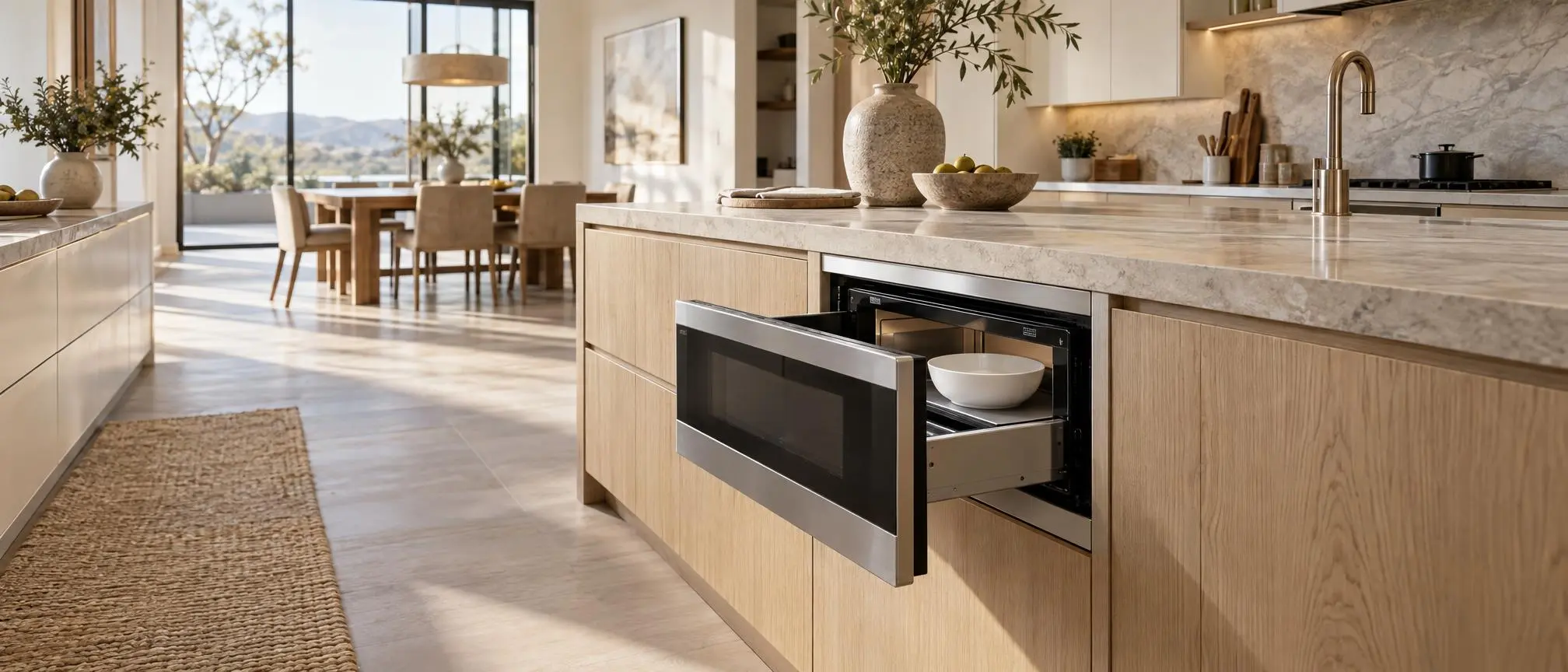
A microwave drawer is an integrated microwave oven which features a sliding drawer rather than a typical side-hinged door.
The unit is typically mounted in lower kitchen cabinets or a properly designed island. When the user wants to cook, they slide the unit out so that they can insert food containers into it from the top.
The way you open it may be different, however the basic cooking technology used in this device is the same as the technology found in a standard microwave.
Microwave heating works by interacting with water molecules present in the food being cooked. The use of a drawer mechanism to provide access to the cooking area is a way to change how users interact with the cooking chamber.
A key difference between the two is how they interact with the other parts of your kitchen.
A drawer style micro wave has its own area within the cabinet to integrate with the rest of the cabinets, so it doesn’t take up any of the top counter space, which is what a standard microwave does. This allows you to have a cleaner look for your kitchen and gives you more space to prepare food.
This machine can be especially handy when kitchen counter space is limited, or when homeowners want to keep their home organized with a clean, orderly layout.
However, the proper installation of such a unit is dependent upon proper planning of the cabinet space and electrical wiring.
How Does a Microwave Drawer Work?
A microwave drawer utilizes the same fundamental microwave heating principles utilized by conventional microwave ovens.
Inside the appliance, there are electronic components that create electromagnetic waves which interact with the food. Electromagnetic waves transfer energy to the food, creating heat.
The heating of food occurs when the water and other chemicals in the food absorb energy from the microwave. After being absorbed, the energy travels throughout the food via conduction.
In addition to the fact that microwave heating isn’t completely even, it’s also a good idea to stir, rotate and let your food sit for a few minutes after you have microwaved it so that you get better results.
Opening the Cooking Compartment
A microwave drawer has a sliding feature which enables its cooking area to slide out.
The way that the drawer is designed will determine whether it opens via a computer controlled system or manually.
The user may access the unit’s interior after opening the lid. Users may then place an appropriate container inside the unit’s cooking chamber by lowering it down through the opening rather than having to reach far into the horizontal compartment.
The drawer must be fully closed before cooking begins.
Selecting Cooking Settings
The microwave drawer usually offers settings to adjust how long food is heated, what amount of power is used during heating, and which cooking functions are available.
Other designs can also include cooking features based on sensors that will change the way they operate depending on what is happening around them.
Using lower power settings is useful for softer foods and those requiring less heat for re-heating.
Higher levels of electrical energy may be required for many purposes including heating up a beverage and/or cooking an appropriate convenience food.
Actual functions vary by appliance design.
Heating the Food
Once you begin to cook, the microwave applies energy to the food within the compartment.
The food absorbs energy, producing heat that spreads through its contents.
The shape of the food, the thickness of the food, the moisture content of the food, and how you arrange the containers will all have an impact on how consistently the food heats.
Therefore, you should follow two key aspects of cooking: distribute your food evenly when cooking, and follow the manufacturer’s suggested stand-time.
Removing the Dish
After cooking, the drawer opens so that users can lift out their dish.
Although the top-opening design allows for items to be removed from the container and/or eaten while they are potentially still very warm, you should use caution.
Oven mitts or other suitable heat protection should be used whenever necessary.
Main Features of a Microwave Drawer
The characteristics of the microwave drawer design differentiate this type of microwave configuration from conventional designs.
Built-In Cabinet Integration
You should install the appliance inside the cabinet, rather than leaving it free-standing on a normal kitchen counter.
The ability for kitchen designers to create an overall layout of coordinated appliances is provided by this.
Cabinet integration will also help to reduce the amount of big appliance’s that are on top of preparation areas.
Sliding Drawer Access
The sliding compartment is one of its defining features.
Rather than opening a vertical door, users pull out the cooking chamber towards themselves.
This changes the direction from which you insert and remove food containers.
Accessible Control Placement
Controls are generally positioned near the upper front portion of the appliance.
Depending on the design, these panels can either be continually visible or accessible after opening a control panel.
In general, having a good view of the controls on your appliance will be very beneficial for you if you plan to install it below the counter top.
Flexible Cooking Functions
Functions often included are to reheat food, thaw out food, set a time for cooking, and adjust the amount of power.
Certain appliances also provide automatic programs for specific food categories.
Therefore, it is important to realize that although some functions may appear similar in each design, they will most likely have different features.
Integrated Appearance
Depending on how you install it, you can mount the appliance either completely flush against the cabinet faces or slightly offset from them.
The result is a unified look that will be suitable for many modern kitchens.
Benefits of Using a Microwave Drawer
When designed for a specific home’s requirements and the size of the kitchen, a microwave drawer provides functional advantages.
Saves Valuable Counter Space
Counter space is an important consideration in many kitchens.
Countertop appliances traditionally take up space that you can utilize for meal prep (e.g., chopping veggies), meal preparation, and ingredient organization.
Installation of your microwave within your cabinet space will allow you to maintain an open area for food preparation.
This can make a noticeable difference in smaller kitchens or busy households.
Creates a Cleaner Kitchen Appearance
Microwave drawers reduce visual clutter by integrating your cooking appliances within your cabinetry.
Instead of placing the appliance in plain view on the top of your counter, this design integrates the appliance into the entire layout of the kitchen.
This can complement minimalist, transitional, or contemporary interiors.
However, appearance alone should not determine appliance placement.
Accessibility and practical kitchen workflow remain equally important.
Allows Convenient Loading From Above
A microwave drawer allows food to be lowered into its compartment from above.
The use of this method may be especially useful for cleaning shallow bowls, plates, and other dishes with liquid contents.
Users can often see the container more clearly while placing it inside.
Nevertheless, the drawer’s height relative to the user matters considerably.
Some people find that low-mounted systems can be uncomfortable, particularly when it’s hard to bend.
Supports Flexible Kitchen Layouts
The device can be installed into an existing kitchen island, a lower level of cabinets, or any other method approved by the manufacturer.
The ability to plan for both the main cooking space and the microwave separately is now possible.
In other words, a household would rather have its reheating function separate from the main cooking area in order to allow more room for people preparing meals.
Location depends on movement, cabinet construction, and how a family lives daily.
Offers Familiar Microwave Cooking Functions
A microwave drawer is still designed primarily for typical microwave tasks.
These could involve using your microwave to heat up leftovers, warm drinks, thaw food items that are appropriate for use in the microwave, and cook foods based upon their respective microwave directions.
The distinctive benefit is not necessarily faster cooking.
Rather than being different in other ways, the primary differences are how easily you can use each type of appliance, where they fit into your kitchen design, and whether or not you will be able to integrate them with your existing kitchen.
Disadvantages of a Microwave Drawer
While a microwave drawer has several advantages, it may not always be the right choice for each homeowner’s kitchen.
Before starting your cabinet installation project, you should know what your product can do.
Requires Dedicated Cabinet Space
Built-in appliances take up space that could be used for shelving, drawer space, and/or other storage options.
This can be an important compromise in compact kitchens.
In addition, the structure of the cabinet must be capable of supporting the appliance and meeting all applicable installation criteria.
Installation Can Be More Complicated
Unlike a portable counter-top model, most built-in drawer units will require the installation of an appropriate size cabinet opening.
Electrical accessibility, structural support, airflow and spacing requirements must be taken into account.
Poor installation can create operational and safety problems.
Lower Placement May Be Uncomfortable
A few people may prefer to place their dispenser under the counter because they find this location to be more accessible, while others find that positioning the dispenser there makes access to the dispenser more difficult.
Frequent bending can be inconvenient for people with limited mobility.
You must take electrical accessibility, structural support, airflow, and spacing requirements into account.
Drawer Mechanisms Require Care
A sliding assembly includes moving components that need to operate smoothly.
Tracks with obstructions, spills, and/or bad handling will cause problems when trying to use them.
Users should avoid forcing the drawer if it becomes stuck.
Capacity Depends on the Internal Cavity
Manufacturers can design microwave drawers to offer different amounts of cooking space than other microwaves sharing the same outside measurements.
Even though your cabinet may seem to have plenty of room, you might not be able to fit large or tall items inside.
Therefore, internal dimensions suit your cooking requirements better than the external size of the appliance alone.
Microwave Drawer vs Traditional Microwave
Microwave Drawer vs Traditional Microwave
A microwave drawer differs from a conventional microwave mainly in access, installation, and how it occupies kitchen space.
Both appliance types use microwave energy to heat food, but their physical configurations influence everyday convenience.
| Feature | Drawer-Style Microwave | Traditional Microwave |
| Opening mechanism | Sliding drawer | Hinged door |
| Food access | Primarily from above | Primarily from the front |
| Typical placement | Built into cabinetry | Countertop or suitable built-in location |
| Countertop use | Usually none | Depends on configuration |
| Installation | Requires compatible cabinet | Depends on appliance type |
| Cleaning access | Top-access cavity | Front-access cavity |
| Cooking method | Microwave heating | Microwave heating |
| Kitchen appearance | Integrated | Varies by placement |
Which Layout Is More Convenient?
The answer is dependent upon the users height, level of physical comfort, how their kitchen is laid out, and the type of cooking they do.
An under counter arrangement might allow for the lowering of specific containers into the cooking section.
A person who wants to avoid bending down may find that placing the microwave higher up is more suitable for their needs.
Neither design is universally more accessible.
Does One Type Heat Food Better?
A microwave with a sliding door (or “drawer”) will not have an advantage in terms of heat generation, just due to its use of a slide-out design.
Several factors determine cooking performance, including how you control the temperature (power control), how well the oven is designed inside (cavity design), where you place your food when preparing it for cooking (food arrangement), and what type of cooking method you use (cooking technique).
A well-designed traditional microwave may heat food just as effectively.
The principal difference is the appliance’s installation and access method.
Where Can a Microwave Drawer Be Installed?
When deciding where to install your microwave drawer, you need to consider the cabinet construction, available electricity, airflow in that area, and household traffic patterns.
Under the Kitchen Counter
Below-counter installation is a common arrangement.
By being built-in within the base cabinet system, the appliance provides a clutter-free work surface.
When there are other drawers and cabinets that you plan on placing near your appliances, this works very well.
However, there must be adequate clearance for the drawer to open completely without hitting knobs, other pieces of furniture, or the surrounding walking space.
Inside a Kitchen Island
A microwave drawer may also be installed in a suitable kitchen island.
With this placement of the microwave oven, you will have a shorter distance to walk from where you prepare food to where you serve it.
It may also help distribute activity across a large kitchen.
The island needs to have the proper structure and electrical hookups.
Because the drawer extends into the surrounding area when it is opened, there needs to be sufficient walking space.
Within a Dedicated Appliance Zone
Some kitchens group smaller cooking appliances in a dedicated area.
The use of a drawer style microwave can be included in this setup as long as the cabinetry has been built to accommodate it.
These kinds of configurations help organize a person’s work flow because the various areas for storage, heating, and serving are located in a similar area.
Locations That Need Extra Consideration
Avoid selecting locations based only on appearance.
For example, you should avoid installing your system in areas with potential obstructions, such as near narrow passageways, room corners, or where cabinet doors might collide when opened.
Also think about where children, pets, and other family members will go as you remove hot foods.
Microwave Drawer Installation Requirements
The installation of a microwave drawer should follow the manufacturer’s specific installation guidelines, as well as any applicable local electrical and/or building codes.
There are many different types of units, and therefore there is no one type of cabinet opening or ventilation that will be appropriate for all units.
Cabinet Dimensions
The cabinet opening needs to be within the dimensions and tolerances that are outlined in the specifications for the appliance.
Check the required width, height, depth, and support arrangements.
The front panel also needs room to open without obstruction.
Structural Support
Built-in appliances can be substantial in weight.
The cabinet supporting the unit should be able to support the required weight of the equipment, remain stationary, and have sufficient structural integrity.
If an appliance lacks proper support, it can move out of position, become misaligned, or even cause problems with how the drawers operate.
Electrical Requirements
The electric hook-up has to meet the requirements of the unit’s rated voltage, current, ground and circuitry.
These specifications vary by model and country.
Electrical work should be completed by a qualified professional where required.
Extension cords and other types of temporary wiring are not acceptable alternatives to approved installation methods.
Ventilation and Clearance
A microwave drawer must meet the clearance and air flow requirements of the installation manual.
Blocking designated airflow routes may result in overheating issues and other operational difficulties.
Cabinet panels, trim, or decorative materials must not interfere with vents.
Professional Installation
You should obtain professional help if you need to modify your cabinets or handle any electrical wiring work.
You should obtain professional help if you need to modify your cabinets or handle any electrical wiring work.
Proper installation helps support reliable operation and safe use.
How to Choose the Right Microwave Drawer for Your Kitchen
More than just selecting the look of your microwave, there are other factors that should be considered when purchasing a microwave drawer.
Before choosing cabinets, it would be best to consider the day-to-day needs of your home.
Consider Your Cooking Habits
Think about how frequently the household uses microwave cooking.
Some people primarily reheat beverages and leftovers.
Others regularly defrost ingredients, warm prepared meals, or cook vegetables.
The most useful functions depend on these routines.
Check Interior Dimensions
Measure the plates, bowls, and food containers normally used in the kitchen.
A wider than normal appliance exterior does not guarantee that extra large pots and pans can be used within the appliance.
Internal usable space and container height are particularly important.
Evaluate Control Accessibility
Controls should be easy to see and operate from a comfortable position.
Determine if family members will be able to view the screen of an under counter appliance without being forced to bend over uncomfortably.
Examine Drawer Operation
The drawer should move smoothly and close securely.
Consider how much space it occupies when fully extended.
The opening should not hinder the function of the adjacent cabinets or your ability to move about the kitchen.
Think About Long-Term Maintenance
Microwave drawers must be positioned where regular cleaning and professional service, when required, may occur.
Cabinet placement should not permanently obstruct required service access.
You must position microwave drawers where you can easily perform regular cleaning and professional service when needed.
Is a Microwave Drawer Safe?
A microwave drawer will generally be a safe appliance if it complies with all safety requirements, you install it properly, and you operate it in accordance with the manufacturer’s guidelines.
Microwave ovens use non-ionizing electromagnetic radiation to heat food.
This does not make food radioactive.
The majority of safety issues arise from excessive temperatures, using improper containers, damaged equipment, or working with hot liquids.
Use Suitable Containers
Choose cookware that is clearly suitable for microwave use.
Microwave-safe glass and ceramic containers are often appropriate.
Some plastics are also appropriate to use in microwaves if they have been marked as safe for this type of use.
Do not put plain metal pots/pans into the unit and do not use unapproved metallic packaging.
Prevent Burns
Hot food, steam, and heated containers can cause burns.
Open covered containers with care so that the steam can exit in a direction that is opposite of where your face and hands are located.
Use suitable protection when removing dishes.
Keep the Drawer Mechanism Clear
Never try to force a drawer shut if there are dishes, utensils, or other items that are blocking it from closing.
Avoid placing fingers near closing edges.
Children should be supervised when using microwave appliances.
Check the Door and Seals
If the cooking area has been damaged, cannot be properly closed, or seems to have malfunctioning safety features, you must not use your microwave drawer.
Stop using the appliance if it operates while open.
Qualified service is necessary for suspected safety-system problems.
How to Clean a Microwave Drawer
Cleaning on a regular basis will help keep the area hygienic, reduce the amount of odor, and avoid food residue buildup.
The best cleaning approach is gentle and consistent.
Step 1: Allow the Appliance to Cool
Before washing your microwave drawer, make sure the cooking process has ended and that you can touch all internal areas without getting burned.
Follow the directions for turning off or disconnecting power before you begin cleaning.
Step 2: Remove Loose Food Debris
Use a soft cloth or suitable sponge to remove crumbs and loose residue.
Pay attention to corners where food particles may collect.
Avoid pushing debris into mechanical openings.
Step 3: Wipe Interior Surfaces
Generally speaking, a soft cloth moistened with water and mild detergent can be used for general routine cleaning as long as the appliance’s manual allows for such.
Avoid abrasive materials that could damage protective interior finishes.
Step 4: Clean Around the Opening
Carefully wipe the accessible edges and surrounding surfaces.
Do not pour water into tracks, controls, vents, or concealed components.
Step 5: Dry the Surfaces
Remove remaining moisture using a clean cloth.
Allow the cooking compartment to dry before operating it again.
Step 6: Maintain a Simple Cleaning Routine
Light cleaning after spills is usually easier than removing dried food later.
Regularly cleaning the oven interior can improve your overall experience using the oven, as well as help eliminate unpleasant smells.
Common Microwave Drawer Problems
Operating issues with a microwave drawer could be due to incorrect setup, how you place your food, or even a mechanical problem.
While some general troubleshooting can be done by a user, internal mechanical and electrical repairs should only be performed by a certified professional.
The Drawer Does Not Open Smoothly
Check whether an object is obstructing the opening.
Do not force the mechanism or attempt to dismantle it.
If the drawer continues to stick, stop using it and seek appropriate service.
Food Heats Unevenly
Uneven heating is not exclusive to drawer-style appliances.
This can happen if the food is too thick, the heat is applied inconsistently throughout the dish, or there was not enough “standing” time allowed after the heating process.
Stir food at the right times; lay out food so that it is spread out equally; follow safe guidelines for reheating.
The Controls Do Not Respond
Check if your control lock feature has been activated by checking your user manual.
Professional assessment may be required if the screen and/or controls do not respond.
The Appliance Makes Unusual Noises
Some operating sounds are normal, including ventilation and mechanical movement.
However, if your computer is making sudden grinding sounds, unusual clicks that occur repeatedly, or any other type of sound that you don’t typically hear, then there may be an issue with your computer.
Stop using the appliance if a mechanical fault is suspected.
The Drawer Does Not Close Completely
A dish may be too large, incorrectly positioned, or obstructing movement.
Remove the obstruction without forcing the drawer.
If the mechanism remains misaligned, arrange professional inspection.
Does a Microwave Drawer Use More Electricity?
The fact that a microwave drawer opens differently than other microwaves does not mean it consumes more electrical power.
Energy consumption depends on rated input power, cooking duration, heating efficiency, standby consumption, and usage patterns.
Some of the other electrical devices that use electricity, although how much will depend on what type of appliance it is, include automatically opening systems and electronically controlled devices.
Microwave Cooking and Energy Efficiency
Microwave cooking can be a cost effective way to prepare some of your favorite foods when compared to other types of cooking appliances (i.e. conventional ovens). This is due to the fact that microwave cooking does not require the use of a large conventional oven cavity to heat up food items.
In addition, the energy efficient operation depends upon the amount of food being prepared, the type of cooking that will occur, and what equipment is used.
To make a valid comparison, rely upon the real electrical specifications and usage of appliances, not how they appear.
Microwave Drawer Design Ideas for Modern Kitchens
The placement of a microwave drawer depends on how you plan your kitchen cabinets around it.
Minimalist Kitchens
A minimalist layout can be defined by the use of clean surfaces and matching cabinets.
The installation of the microwave below the counter top may preserve those same qualities.
Open-Plan Kitchens
The way appliances are positioned within an open-plan space will affect the view of your kitchen from surrounding living spaces.
Integrated equipment can help create a visually consistent arrangement.
Compact Kitchens
Smaller kitchens benefit from thoughtful organization.
The process of moving the microwave off of the counter top will allow you to create more room for meal preparation. However, as well as allowing you to have more counter space for preparing meals, this action will reduce your overall storage capacity within your cabinets.
Kitchen Islands
An island installation can position the appliance near seating or serving areas.
The open drawer must also be positioned so as not to cause an impediment to movement through the circulation path as well as not pose a risk of injury from someone tripping over it.
Family Kitchens
When you have a large family that uses the kitchen at various times of the day, choose a location for your refrigerator based on the way everyone will utilize the space.
A good compromise is to create an accessible work area where employees can easily be supervised while they handle hot food safely.
Common Mistakes to Avoid
Several planning mistakes can reduce the practicality of a microwave drawer.
Don’t use just the outside dimension of a microwave oven. Check out how much space inside is available.
The uncomfortable height selection should be based upon whether you will use the space while standing up or sitting down in relation to the people living with you.
Follow the manufacturer’s installation directions for the proper amount of ventilation and clearance around your appliance.
Ensure that when you open your drawers they will not hit other nearby items such as cabinet doors or walkways.
Using unsuitable cookware: Only use containers approved for microwave cooking.
If a component has failed and cannot be operated, it could indicate that there is mechanical resistance and you should seek assistance from a professional.
Don’t ignore the need to clean: Residue and spills need to be cleaned up as soon as possible after they occur so that they don’t build up.
The electric assessment needs to happen prior to finalizing the cabinets.
Creating a better functioning, and reliable kitchen setup will help avoid many of the above-mentioned problems.
Frequently Asked Questions About Microwave Drawer
What is the main purpose of a microwave drawer?
A microwave drawer is an alternative way of providing access to microwave cooking functions using a slide-out compartment that fits into existing kitchen cabinets. There are three key benefits associated with a microwave drawer: ease of use/accessibility, positioning of the appliance/placement, and organization on the counter top.
Is a microwave drawer better than a regular microwave?
A drawer-style microwave isn’t always the best option. Some individuals who want their appliances integrated into their cabinets and like the idea of being able to load from above might find a drawer-style microwave to be the right choice. However, in most types of kitchen configurations, a standard microwave would likely be more user-friendly.
Can a microwave drawer be installed under a countertop?
Yes, many drawer-style microwave ovens can be installed below a counter top. The size of the opening in your cabinets, the electrical supply to the oven, the ventilation for the oven, and the support needed for the oven all need to be within the manufacturer’s specified requirements.
Can you install one in a kitchen island?
The answer is yes. This is provided that the island has sufficient structural support, electrical access, and operating clearance, and that the appliance being installed is approved for such an installation.
Does a microwave drawer need ventilation?
The manufacturer of a microwave drawer has outlined how much space (clearance) and airflow are required for proper function of the unit, which is described in the manufacturer’s installation manual. The requirements for venting vary from one type of appliance to another.
Is a microwave drawer safe for everyday use?
Yes, as long as the item has been correctly set up, is being kept in good shape, and you are using it safely per the safety guidelines. Important things to consider include using proper containers, being cautious while handling warm food, and making sure that the closing mechanism is working correctly.
Can you cook food in a drawer microwave?
Yes. The oven can perform typical microwave cooking operations such as heating, reheating, and defrosting of food items that are suitable for use in a microwave.
Is cleaning difficult?
Cleaning is relatively easy if you deal with spills of food as soon as they happen. You will be able to clean the area using a soft cloth, some gentle soap, and paying close attention to the opening. This should help keep up with your regular cleaning.
Does a drawer microwave need a turntable?
Not always. There are different types of internal heating arrangements based upon how each system was designed. Many systems are designed with no necessity for a rotating plate.
Can a microwave drawer replace a conventional oven?
Normally a microwave drawer will not directly replace an existing conventional oven. Conventional oven cooking methods such as roasting, baking and browning cannot be achieved with the use of most microwave functions.
Is a drawer microwave suitable for a small kitchen?
The advantages include saving counter-top space. On the other hand, there will be less space in the cabinets for other items because you used the space to install the product.
What should you check before installation?
Review cabinet measurements, electric requirements, air flow needs, structure support, how much space you will have for drawers, how easy it will be to get to the appliance and read the installation directions for your appliance.
Final Thoughts
The use of a microwave drawer represents an alternative method for incorporating the use of microwave cooking into a kitchen. This type of microwave is designed with a slide out drawer that provides access to the contents of the drawer from above, and also enables the microwave unit to remain inside the cabinetry, as opposed to being placed on top of a work surface.
For many families, having an appliance located above the range will help organize the counters and give the kitchen a cleaner look. Also, the location makes it easier for you to use your dishes. However, for other families the low installation location, cabinet requirements and/or maintenance issues associated with an appliance over-the-range may make a standard microwave more suitable.
The single most critical choice for a homeowner isn’t if an appliance appears current-day, but rather how well that appliance meets the daily cooking needs of the family.
Homeowners can better decide whether or not to include a drawer-style microwave into their home’s kitchen design by being knowledgeable of the installation requirements, safe operating procedures, cooking performance and maintenance over time.
, and maintenance requirements, you can become a more confident computer user.
Once you have a general understanding of what constitutes a “PC,” there are many areas of study that will help you grow in your comprehension. These include computer hardware, operating systems, memory/storage devices, and network communication.