
A backsplash covers maybe 30 square feet, yet it decides whether your kitchen looks current or dated. It sits at eye level, directly behind the surface you use most, and it is the one finish that touches cabinets, countertop, and hardware at the same time.
That is why modern kitchen backsplash ideas get searched more than almost any other kitchen upgrade. It is a small area, a manageable budget, and a disproportionate visual return.
This guide covers 28 designs, honest cost ranges, material trade-offs that installers actually care about, and the mistakes that force people to redo the job within two years.
Quick Answer: What Makes a Backsplash Look Modern
Four things separate a modern backsplash from a dated one:
- Slab or large-format tile instead of small mosaics
- Minimal grout lines — thin joints, matched grout color
- Full-height coverage to the underside of the upper cabinets, or all the way to the ceiling
- Matte or honed finishes rather than high-gloss
If you apply only those four principles, almost any material will read as current.
Material Comparison: Start Here
Most people choose a look first and a material second. Reverse that order. The material determines your cost, your cleaning routine, and whether the installation takes one day or three.
| Material | Cost/sq ft installed | Durability | Cleaning | Best for |
| Ceramic tile | $12–$28 | High | Easy | Budget-conscious, most kitchens |
| Porcelain slab | $55–$120 | Very high | Very easy | Seamless modern look |
| Quartz slab | $60–$135 | Very high | Very easy | Matching the countertop |
| Natural stone (marble) | $50–$110 | Medium | Needs sealing | Statement veining |
| Glass tile | $25–$60 | High | Easy | Light reflection, color |
| Zellige / handmade tile | $35–$80 | Medium | Moderate | Texture and variation |
| Stainless steel | $30–$70 | Very high | Easy | Pro-style, behind range |
| Concrete / microcement | $30–$65 | Medium | Needs sealing | Seamless minimal |
| Peel-and-stick | $5–$12 | Low | Easy | Renters, temporary |
Cost ranges are US national averages and vary significantly by region and labor market — get local quotes before budgeting.
28 Modern Kitchen Backsplash Ideas
Slab and seamless looks
1. Full-height quartz slab. The countertop material continues straight up the wall. Zero grout lines, one continuous surface, and the single most requested modern look right now. Expensive, but it eliminates the seam between counter and wall entirely.
2. Book-matched marble. Two slabs mirrored along the center line so the veining creates a symmetrical pattern. Dramatic, and best used on one focal wall only.
3. Porcelain slab in a stone print. Gets the marble look without the sealing, etching, or staining. Increasingly the practical choice over real marble.
4. Microcement. A troweled cement finish with no joints at all. Warm, matte, slightly imperfect. Requires a skilled applicator and proper sealing.
5. Single-slab statement behind the range. Slab only where it matters, standard tile elsewhere. Cuts the cost roughly in half.
Large-format tile
6. 12×24 porcelain, stacked. Vertical stacking with matched grout reads taller and cleaner than a running bond.
7. 24×48 tile with micro-joints. Fewer lines, bigger visual field. Requires a very flat wall — budget for leveling.
8. Full-height to the ceiling. Skipping the upper cabinets and running tile floor-to-ceiling on one wall is a strong modern move in open-plan kitchens.
9. Matte black large-format. Bold, but pair it with warm wood cabinetry or it goes cold fast.
10. Fluted or ribbed tile. Vertical grooves add shadow and texture without pattern. One of the fastest-growing looks in 2026.
Tile shapes that read modern
11. Vertical stacked subway. The classic subway tile, turned 90 degrees. Same low cost, far more current.
12. Elongated 2×12 or 3×12 tile. Longer proportions feel contemporary where standard 3×6 feels dated.
13. Square grid in a large format. 8×8 or 12×12 squares, stacked, with tight joints.
14. Zellige tile. Handmade Moroccan tile with visible surface variation and irregular edges. Adds warmth and imperfection to otherwise flat modern kitchens.
15. Kit-Kat / finger mosaic. Thin vertical sticks, usually glossy. Works well as a small accent zone.
16. Hexagon in oversized format. Modern when the hex is 6 inches or larger; dated when it is small.
17. Picket / arabesque, tonal. Shape interest with color restraint — keep it monochrome.
Color directions
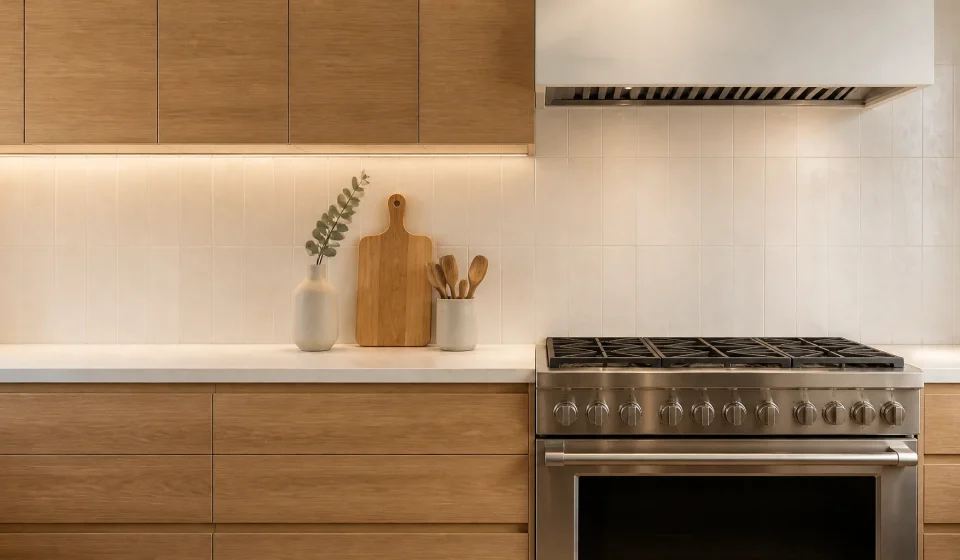
18. Warm white with matched grout. The safest modern default, and it never fights with anything else.
19. Greige and putty tones. Replacing cool gray across US kitchens, and far more forgiving under warm lighting.
20. Deep green or forest tile against natural oak cabinets.
21. Terracotta and clay tones. Warm, earthy, currently rising.
22. Tonal monochrome. Backsplash, counter, and cabinets in shades of the same hue. Quiet and expensive-looking.
23. High-contrast dark grout, used deliberately. Only works with a simple tile shape and precise installation — it highlights every flaw.
Material-forward looks
24. Stainless steel behind the range. Practical, heat-proof, easy to wipe. Pairs well with pro-style ranges.
25. Brushed brass or antique bronze sheet. Warm metallic that patinas over time.
26. Wood-look porcelain. Warmth of wood, none of the moisture risk.
27. Glass panel in a solid color. Back-painted glass gives a seamless, wipeable surface with no grout at all.
28. Peel-and-stick for renters. Modern patterns exist now that do not look plastic. Temporary, but genuinely useful.
Design Rules That Keep It Modern
Rule 1: Fewer grout lines
Grout lines are what separate a 2010 kitchen from a 2026 one. Larger tiles, thinner joints, and grout matched to the tile color all reduce visual noise.
Rule 2: Extend the height
A backsplash that stops at 4 inches looks unfinished. Standard modern height runs from the countertop to the underside of the upper cabinets — usually 18 inches. Full-height to the ceiling behind the range or on an open wall is stronger still.
Rule 3: Coordinate finish levels
If your cabinets are matte and your hardware is brushed, a high-gloss backsplash will fight both. Keep the sheen levels within one step of each other.
Rule 4: Let one element speak
If the countertop has heavy veining, keep the backsplash quiet. If the backsplash is the statement, keep the counter plain. Two loud surfaces cancel each other out.
Rule 5: Terminate edges cleanly
How a backsplash ends matters as much as how it looks. Options: a metal Schluter trim, a mitered tile edge, or running the tile to a natural stopping point like a wall corner or window frame. An unfinished cut edge undoes an otherwise good job.
Cost Planning: What Actually Drives the Number
Material is rarely the biggest line item. These four factors move a backsplash budget more than tile choice:
Wall preparation. Large-format tile and slab need a flat substrate. If your drywall is uneven, expect $200–$600 in leveling before anything goes up.
Outlet handling. Every outlet is a cut. Moving outlets under the cabinets or into a power strip channel costs more upfront but delivers the clean uninterrupted look people are actually after.
Cut complexity. Mitered corners, waterfall edges, and precise slab cuts require a fabricator, not a tile setter. Different trade, different rate.
Removal of the existing backsplash. Budget $150–$400 for demolition and drywall repair if something is already there.
Rough project totals
| Project scope | Typical installed total |
| 30 sq ft ceramic tile | $400–$900 |
| 30 sq ft large-format porcelain | $900–$1,800 |
| 30 sq ft quartz slab | $1,800–$4,000 |
| Range-wall slab accent only | $700–$1,500 |
| DIY peel-and-stick | $120–$350 |
Verify against local quotes — labor rates vary widely across US metros.
Matching Your Backsplash to What You Already Have
White or light cabinets
You have the most freedom. Warm white tile with matched grout is the safe modern default. For more interest, try fluted tile, zellige, or a warm greige large-format.
Dark or navy cabinets
Go lighter on the backsplash to keep the room from closing in. Warm white, pale greige, or a soft veined porcelain slab all work. Avoid dark-on-dark unless you have strong natural light.
Natural wood cabinets
Wood is currently the dominant direction in modern US kitchens. Pair it with warm neutrals, terracotta, deep green, or a honed stone-look slab. Avoid cool grays — they clash with wood undertones.
Busy granite countertops
Keep the backsplash completely plain — a single-color matte tile or a solid slab. Do not try to match the granite’s pattern; you will lose.
Stainless appliances throughout
Anything works, but warm materials balance the coolness of steel better than more metal does.
Installation: DIY or Hire Out?
Reasonable to DIY
- Peel-and-stick
- Standard ceramic or subway tile on a flat wall
- Small accent areas
Budget a full weekend for a first-time tile job, plus a tile saw rental and about 15% extra tile for cuts and breakage.
Hire a professional
- Any slab material
- Large-format tile over 12×24
- Zellige or handmade tile with irregular edges
- Any wall needing leveling
- Anything involving outlet relocation
The tell: if the material requires a fabricator or a perfectly flat substrate, the labor savings from DIY disappear into repair costs.
Seven Mistakes That Date a Backsplash Fast
- Small mosaic tile everywhere. The single strongest dating signal in kitchen design.
- Contrasting grout with busy tile. It doubles the visual noise.
- Stopping at 4 inches. Reads as an unfinished builder-grade kitchen.
- Choosing tile before the countertop. The counter is the harder decision — settle it first.
- Ignoring lighting. Under-cabinet LEDs change tile color noticeably. Test samples with your actual lighting, at night.
- Glossy finishes in a bright kitchen. Glare at eye level is genuinely unpleasant to work under.
- Unsealed natural stone behind the range. Oil, tomato, and citrus will mark it within months.
How to Test Before You Commit
Order samples — always more than one — and tape them to the wall for at least three days. Look at them in morning light, in afternoon light, and under your under-cabinet lighting at night. Colors shift dramatically between those three conditions, especially whites, which can read pink, yellow, or blue depending on the fixture temperature.
Also hold the sample directly against your countertop and cabinet door at the same time. Undertone clashes only appear when all three surfaces are touching.
Frequently Asked Questions
What backsplash is most modern in 2026?
Full-height slab and large-format tile with minimal grout lines. Fluted and textured tiles are the fastest-growing alternative for people who want dimension without pattern.
How high should a modern backsplash go?
From the countertop to the underside of the upper cabinets, typically 18 inches. Full-height to the ceiling is stronger on open walls and behind the range.
Is subway tile still in style?
Yes, but the orientation matters. Vertical stacked or elongated 2×12 formats read current; standard 3×6 in a running bond with contrasting grout reads dated.
What is the cheapest modern backsplash?
Large-format ceramic tile in a warm white with matched grout. It delivers the modern look at the lowest material and labor cost.
Should the backsplash match the countertop?
It does not have to, but running the counter material up the wall is one of the cleanest modern options. If they differ, keep one plain.
Do I need to remove the old backsplash first?
Usually yes. Tiling over existing tile adds thickness that interferes with outlets and cabinet edges, and it risks the whole assembly failing.
What grout color looks most modern?
Grout matched as closely as possible to the tile. It minimizes the grid effect and lets the material read as a surface rather than a pattern.
How long does installation take?
A standard tile backsplash takes one to two days plus grout curing. Slab installation is often a single day but requires a week or more of lead time for templating and fabrication.
Where to Start
Settle your countertop first, then pull three backsplash samples that coordinate with it. Tape them up for three days and check them under all your lighting conditions. Choose the one that still looks right on day three, not the one that looked best on day one.
Then apply the four modern principles — large format, minimal grout contrast, extended height, restrained finish — and the result will read current for years rather than seasons.