Wall Decor: The Complete 2026 Guide to Styling Every Wall in Your Home

Most people hang their art too high, buy it too small, and wonder why the room still feels unfinished. Wall decor is the single cheapest fix in interior design, yet it is also the one most homeowners get wrong — usually by inches.
This guide fixes that. Below you will find exact sizing math, hanging heights measured room by room, thirty ideas organized by budget, and the mistakes that quietly ruin otherwise good rooms. Everything here is measured in inches and dollars, because that is how decisions actually get made.
Quick Answer: The Three Rules That Matter Most
If you read nothing else, take these:
- Hang the center at 57–60 inches from the floor. That is average US eye level and standard museum height.
- Size your piece to 60–75% of the furniture width below it. A 90-inch sofa needs 54–68 inches of art.
- Leave 6–8 inches between the top of the sofa and the bottom of the frame.
Get those three numbers right and your wall decor will look professionally placed even if the art itself was $30.
Why Walls Decide How a Room Feels
Your walls are the largest uninterrupted surface in any room — typically 400 to 600 square feet in an average American living room, versus maybe 40 square feet of visible sofa. Whatever happens there sets the tone before your eye reaches anything else.
Well-chosen wall decor does four things at once:
- Establishes hierarchy. It tells the eye where to look first, which is why a room without it feels aimless.
- Corrects proportion. Vertical pieces add perceived ceiling height. Horizontal groupings widen narrow rooms.
- Repeats your palette. Repetition is what separates “designed” from “accumulated.”
- Absorbs sound. Canvas, textiles, and woven pieces measurably reduce echo in rooms with hard flooring.
That last point matters more in modern open-plan homes than most people expect. Two large canvases and a woven hanging noticeably soften a room with LVP floors and no curtains.
Step 1: Diagnose the Wall Before You Buy Anything
Every wall has a job. Buying before you know the job is how people end up with a closet full of frames.
The four wall types
| Wall type | Its job | What works |
| Anchor wall (behind sofa/bed) | Backdrop for the main furniture | One oversized piece or a tight grouping |
| Passage wall (hallway, stairs) | Rhythm and movement | A repeating row of matched frames |
| Function wall (office, entry) | Storage plus style | Shelves, pegboards, hooks, slat walls |
| Reflective wall (dining, small rooms) | Light and depth | Mirrors, glass, metallic finishes |
Identify which one you are working with, then choose from that row only. This single step eliminates most bad purchases.
The measuring exercise
Take a tape measure and write down three numbers: wall width, furniture width below it, and clearance height from furniture top to ceiling. Every recommendation below runs off these three numbers.
Step 2: Sizing Math (The Part Everyone Skips)
Undersized art is the most common wall decor mistake in American homes, and it is entirely avoidable.
Sizing above furniture
| Furniture width | Ideal art or grouping width | Common single-canvas size |
| 60″ loveseat | 36–45″ | 36×24 |
| 72″ sofa | 43–54″ | 48×30 |
| 84″ sofa | 50–63″ | 60×36 |
| 96″ sofa | 58–72″ | 60×40 or 2× 30×40 |
| 60″ console | 36–45″ | 40×30 |
| Queen bed (60″) | 36–45″ | 40×30 |
| King bed (76″) | 45–57″ | 48×36 |
Sizing on an empty wall
For a wall with no furniture below it, fill 50–60% of the wall width and center the piece vertically in the visible span, not the full floor-to-ceiling height.
The floor-test trick
Lay your arrangement on the floor in the exact shape you plan to hang, photograph it from directly above, then compare that photo to a photo of the wall. Scale problems that are invisible in person become obvious in a photo.
Step 3: Hanging Heights, Room by Room
| Location | Center height | Clearance rule |
| Standard blank wall | 57–60″ from floor | — |
| Above sofa | Adjust to clearance | 6–8″ above sofa back |
| Above console/credenza | Adjust to clearance | 4–6″ above surface |
| Above bed | Adjust to clearance | 6–10″ above headboard |
| Above fireplace mantel | Adjust to clearance | 4–8″ above mantel |
| Gallery wall (as a block) | Block center at 57–60″ | 2–3″ between frames |
| Stairwell | Follow stair angle | Center each at 57″ from its own tread |
| Above a desk | 24–30″ above desktop | — |
The rule behind the rules: hang relative to the furniture, not the ceiling. Ceiling heights vary from 8 to 12 feet across US housing stock. Sightlines do not.
30 Wall Decor Ideas, Sorted by Budget
Under $50
- Framed fabric. A yard of good upholstery fabric stretched over a thrifted canvas. Roughly $18.
- Public-domain art prints. Download from open museum archives, print at 24×36 at a local shop, clip into a wooden poster hanger.
- Thrifted frames, unified with spray paint. Buy eight mismatched frames, paint them all matte black, instant cohesion.
- Hat cluster. Five straw or felt hats on simple hooks, arranged in an organic curve.
- Wooden dowel textile hanger. A tea towel, scarf, or fabric remnant on a dowel with leather cord.
- Pressed botanicals in float frames — free material, high perceived value.
- Vinyl record sleeves on clear ledge shelves, rotated by mood.
- Peel-and-stick tile accent behind a coffee station or above a desk.
- Painted arch. One curved shape in a contrasting paint color behind a plant or chair. Cost: a sample pot.
- Kids’ art in real frames. Matted properly, children’s work reads as genuine abstract art.
$50–$200
- Large single canvas. Best cost-per-square-inch in all of wall decor. Look for 40×60 print-on-demand options.
- Round mirror. 30–36 inches, placed opposite a window.
- Floating oak shelves. Two staggered shelves styled with a leaning frame, one plant, one object.
- Woven flat baskets. A cluster of three to five in varied diameters and tones.
- Peel-and-stick wallpaper accent wall. Fully renter-safe, removes cleanly.
- Plug-in wall sconces. Function plus sculpture, and they free up table surface.
- Picture ledge rail. Lets you rotate art without new nail holes.
- Vintage map or nautical chart of a city or coastline that means something to you.
- Macramé or fiber wall hanging for texture in a hard-surfaced room.
- Wall-mounted planters with trailing pothos or philodendron.
$200+
- Oversized statement art. One 48×72 piece instead of nine small ones.
- Picture-frame molding, painted wall-color for quiet architectural depth.
- Wood slat accent wall. Adds warmth and acoustic damping simultaneously.
- Antique mirror with a real frame. Estate sales beat retail here consistently.
- Commissioned pet or house portrait. High emotional value, genuinely unique.
- Metal sculptural wall art for rooms lacking hard edges.
- Limited-edition signed print from a working artist.
- Custom framed textile — a kilim fragment or vintage quilt block, float-mounted.
- Built-in shallow shelving across a full wall.
- Nothing. One deliberately bare wall makes the others read as intentional.
Wall Decor by Room
Living room
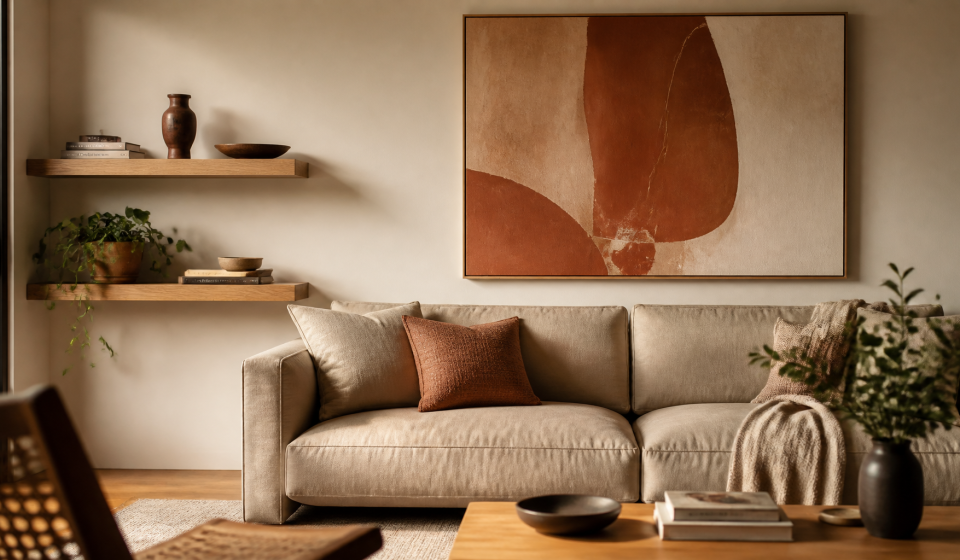
The sofa wall is your feature; everything else supports it. Choose one anchor, then keep the remaining walls quiet — a mirror, a single shelf, or bare plaster. Rooms fail from too much competing, not too little.
Common fix: if your living room feels busy, remove one third of what is on the walls before adding anything.
Bedroom
Prioritize calm. Low-contrast abstracts, soft photography, and textiles suit a room whose job is rest. Avoid sharp graphic energy directly above the headboard, and keep the piece narrower than the bed so the composition reads as settled.
Kitchen and dining
Grease and steam are real constraints, so glass-fronted frames and wipeable surfaces outlast canvas here. A mirror in a dining room is the highest-return move in the house — it doubles candlelight and visually expands the table.
Home office
You look at this wall for six hours a day, so pick what you actually like over what photographs well. Slat walls and pegboards deliver storage and style in the same square footage.
Entryway and hallway
Narrow spaces reward repetition. A row of identical frames at identical spacing creates rhythm and lengthens the corridor. Resist mixing sizes here; variety reads as clutter in tight spaces.
Bathroom
Humidity rules everything. Use sealed prints, ceramic, or metal. Avoid paper art and unsealed wood unless you have strong ventilation.
Rental apartments
Adhesive strips rated 20% above your piece’s actual weight, picture rails, leaning arrangements, and removable wallpaper cover almost every case. Photograph the walls at move-in so you know what “original condition” actually looked like.
Gallery Walls: A Repeatable Method
Gallery walls fail when they are improvised. Use this sequence instead.
- Choose a shape. Rectangle, square, or a horizontal band. The outer silhouette matters more than the individual pieces.
- Pick your anchor. The largest piece goes slightly off-center, never dead middle.
- Unify one variable. Same frame color, same mat color, or same subject matter. One is enough.
- Cut paper templates at each frame’s dimensions and tape them up before drilling.
- Keep spacing constant at 2–3 inches throughout. Inconsistent gaps are what make DIY galleries look DIY.
- Mark hanger positions, not frame corners, on the templates.
- Hang from the center outward.
Nine Mistakes That Undo Good Wall Decor
- Hanging too high. The most frequent error by a wide margin. When unsure, go lower.
- Buying too small. A 16×20 above an 84-inch sofa looks like a postage stamp.
- Filling every wall at once. Rooms assembled over time look richer than rooms bought in one weekend.
- Matching too perfectly. A set of four identical prints from one store reads as a showroom, not a home.
- Ignoring sightlines from the doorway. Stand in the entrance and check what you see first.
- Skipping the anchors. Drywall anchors are rated in pounds for a reason. A fallen mirror costs more than the mirror.
- Hanging above heat. Direct fireplace or radiator heat warps canvas and fades pigment.
- Forgetting the sixth wall. Ceilings take paint and paper too, especially in bedrooms.
- Chasing trends. The piece you still like in five years was never trendy to begin with.
What Is Changing in 2026
Warm neutrals have fully displaced cool grays across US interiors. Dimensional and tactile pieces — plaster, carved wood, ceramic, fiber — are outselling flat prints, largely because homes designed for video calls need surfaces that read well on camera. Meanwhile, single oversized artworks continue to gain on dense gallery walls, since they are simply easier to live with.
Sustainability is reshaping sourcing too. Vintage, secondhand, and made-to-order wall decor now carry more status than mass-produced retail pieces, which is a genuine reversal from a decade ago.
Use trends as input, not instruction. The room that ages well is the one that was never fully on-trend.
Frequently Asked Questions
What height should wall decor be hung?
Center it 57 to 60 inches from the floor. Above furniture, adjust so the frame bottom sits 6 to 8 inches above a sofa back or 4 to 6 inches above a console.
How big should art be above a sofa?
Between 60 and 75 percent of the sofa’s width. For an 84-inch sofa, target 50 to 63 inches of art or grouping width.
How much should I spend on wall decor?
Five to ten percent of your total room budget is a reasonable benchmark. Spend it on one strong anchor piece rather than several fillers, and spend more on framing than on the print itself.
Can I hang wall decor without nails?
Yes. Adhesive strips rated above your piece’s weight, picture rails, tension rods, and leaning arrangements all work in rentals without damage.
How do I fill a very large wall?
Use one oversized piece, a tight symmetrical grid, or art combined with shelving. Avoid scattering small items across a big surface — it reads as clutter, not composition.
What works in a small apartment?
Mirrors, vertical compositions, and wall-mounted storage. They add depth and function without consuming floor space.
Should all my frames match?
No. Unify one variable — frame color, mat color, or subject — and let the rest vary. Total matching looks like retail staging.
How many pieces belong on one wall?
Odd numbers read better than even. One, three, or five. Four items tend to look like a mistake unless arranged in a deliberate grid.
Where to Start This Weekend
Pick one wall — ideally your sofa wall. Measure the furniture below it. Calculate 60 to 75 percent of that width. Buy or make one piece at that size, and hang it 6 to 8 inches above the sofa back.
That single change does more for a room than any other decorating move under $200. Everything else in this guide builds on it.