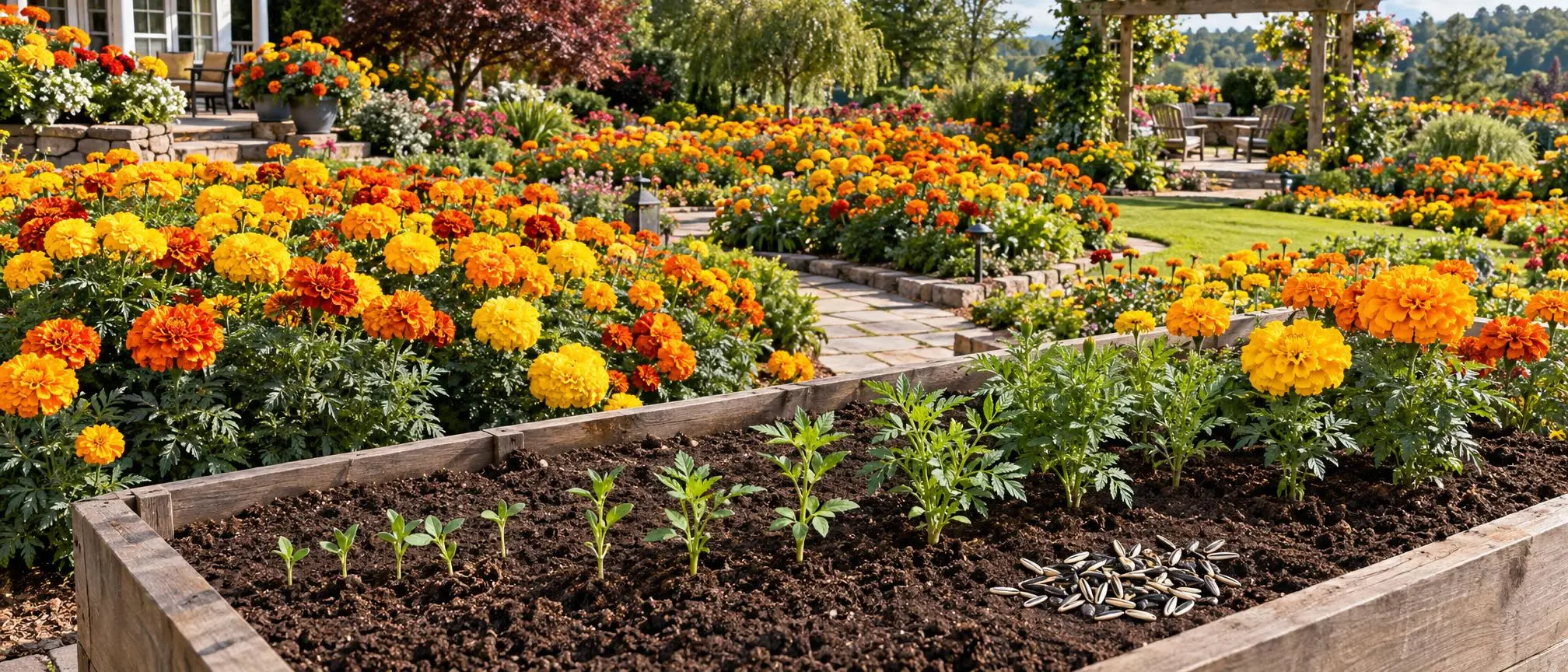

Starting with marigold seeds is a wonderful way to add bright colors of yellow, orange, gold, and dark red to your garden for much of the growing year. Marigolds are popular with both novice and expert gardeners due to their easy-to-care-for nature, simplicity of bloom, and compatibility with numerous gardening environments.
Growing marigolds from seed is one of the easiest ways to develop a beautiful, colorful flower garden using no starter plants. When provided with adequate sunlight, proper soil, and continuous moisture, marigold seeds will grow from small seeds to healthy, colorful flowering plants.
Marigolds are very popular in vegetable gardens, flower borders, raised beds, and container gardening. Additionally, their flowers will draw in pollinators which contributes to a larger variety of plants growing in your garden.
Successful seed starting is much more involved than simply spreading your seeds around on top of the ground.
Understanding when to plant, how deep to put seeds in the ground and how to look after the little plants that come up will help improve your gardening.
This article is a comprehensive guide to understanding all aspects of marigold seeds, including how they germinate, different ways to plant them, water needs, sun exposure, caring for the plants during each season and collecting seeds from your plants so that you can grow more marigolds next year.
What Are Marigold Seeds?
Marigold seeds are the reproductive structures that form on mature marigold flowers. When provided with an environment that allows for growth, these seeds will germinate and grow into new plants.
Most of the common decorative garden marigolds are part of the Tagetes genus; these plants have a number of different varieties that are cultivated for both their beautiful blooms and unique leaf structure.
In most cases, the seeds will look thin and long, with a dark lower portion and a light yellow/straw colored upper part.
Marigolds are typically cultivated as annual plants, which means that each year, the plant will complete its entire life cycle.
They will begin growing, grow their leaves and stalks, bloom with flowers, create seeds, and then start dying when the environment becomes poor.
As with many plants, the successful growth of marigolds is determined by four factors: temperature, moisture, soil drainage, and sunlight.
Seeds that are healthy and in an area where they will grow well are what make plants grow strong and produce many flowers.
Different Types of Marigolds You Can Grow
Understanding what the major types of ornamental marigolds are before you plant your first marigold seed will assist you.
Different varieties have distinct flower sizes, heights, and growth habits.
French Marigolds
French marigolds, often called tagetes patula, generally develop into small, full-bodied plants.
Their flowers may be yellow, orange, red, or a combination of these colors.
They work especially well along garden borders, pathways, and in containers.
Their relatively compact size makes them useful where planting space is limited.
African Marigolds
African Marigold (Tagetes Erecta) typically grows higher than other types of Marigolds and has larger flower heads.
Their rounded blooms create a striking appearance in flower beds.
Taller types can have a need for more space and support on some occasions, particularly in open areas.
Signet Marigolds
Tagetes tenuifolia, commonly known as signet marigold, produces smaller blooms with very finely-cut leaves.
Many times, they will grow to be a soft and thick look that is perfect for borders and ornamental landscaping.
Only those signet marigolds that have been correctly identified, are safe to eat (i.e. meet food safety standards), and were produced in an environment that is conducive to producing safe-to-eat products may be used as ingredients in cooking.
Important Botanical Difference
The Pot Marigold (Calendula officinalis) is not the same plant as the common Ornamental Marigold (Tagetes).
Both of these plants are members of the daisy family; however, each has unique growth habits.
This guide focuses mainly on Tagetes marigolds.
When Is the Best Time to Plant Marigold Seeds?
The timing of planting marigolds is very critical to the success of your marigold plants, especially if you live in an area with harsh cold weather during the winter.
Marigolds are sensitive to frost and generally grow best during warm weather.
Sow seeds outdoors once the risk of spring frost is over and the soil is warm.
Cold, wet soil can slow germination and increase the likelihood of seed failure.
Gardeners wishing to have early blooming plants can start seed indoors, a few weeks prior to the anticipated last frost.
The exact planting date depends on your location.
As an example, gardeners who live in warmer areas of the U.S. can start planting outdoors at a much earlier time than gardeners who live in colder areas of the country where there is a longer winter season.
Rather than adhering to one single national planting date, find out what your local average last frost date is as well as your current soil conditions.
Indoor vs. Outdoor Planting
| Method | Best timing | Main advantage |
| Indoor seed starting | About 4–8 weeks before transplanting, depending on type | Earlier establishment |
| Direct outdoor sowing | After spring frost danger passes | Less transplant handling |
| Later-season sowing | Where enough warm growing time remains | Additional seasonal flowers |
Both approaches can work well when local growing conditions are suitable.
How to Plant Marigold Seeds Indoors
Gardeners can better manage temperature, moisture, and the early stages of a seedling’s growth when starting marigold seeds inside.
It is particularly useful in climates with short growing seasons.
Step 1: Prepare Your Containers
Choose clean seed-starting containers with adequate drainage.
The container should have a way for extra water to flow out of it, instead of having the excess water collect around the growing root system.
Fill them with a loose, well-draining seed-starting medium.
In general, do not plant in heavy, compacted garden soil that can limit air flow and keep too much moisture.
Step 2: Moisten the Growing Medium
Lightly moisten the medium before planting.
It should feel evenly damp without becoming saturated.
Proper moisture helps seeds absorb water and begin germination.
Step 3: Sow the Seeds
Place marigold seeds approximately ¼ inch deep in the growing medium.
Gently press on top of the seeds to ensure that there is contact between the seeds and the damp medium.
Do not plant too deep, since young plants need sufficient stored energy to emerge from the ground.
Step 4: Maintain Suitable Temperatures
A temperature of approximately 70-75 degrees Fahrenheit (F) for the growing-medium will help to ensure fast germination.
Choose a warm location with relatively stable conditions.
Check the moisture levels on a regular basis, and make sure that the medium does not become totally dry when you are growing seeds.
Step 5: Provide Light After Germination
Once seedlings emerge, move them into a bright growing environment.
Insufficient light can cause weak, elongated stems.
Strong, healthy seedlings are better prepared for transplanting.
How to Plant Marigold Seeds Directly Outdoors
Directly sowing marigold seeds into the garden is another simple method.
This is a very good method when it is consistently hot and there is no longer a danger of freezing.
Begin by selecting a sunny planting location.
Loosen the upper soil and remove competing weeds, stones, and other debris.
Improve drainage where necessary, but avoid excessive soil disturbance.
The planting surface should be made smooth and shallow planting holes (about 1/4 inch deep) created.
Place the seeds at suitable intervals and cover lightly with soil.
Water gently to avoid washing them away.
Keep the upper soil consistently moist until germination occurs.
After the seedlings have developed their “true” leaves, remove some of the closely spaced seedlings to give them enough room to grow.
Direct sowing has no transplant stress, however, direct seeded plants will need more care when dealing with weed control, rainfall, and temperature fluctuations.
How Long Do Marigold Seeds Take to Germinate?
Many people who garden ask me, “How long will it take for my marigolds to grow?”
Under optimal circumstances, it is typical for marigold seed to begin to grow within 5-8 days.
However, the exact timing depends on several environmental factors.
Temperature is especially important.
Growing medium temperature may cause delayed germination. Heat that is too high will negatively impact seed growth.
Moisture also matters.
Seeds require adequate moisture for germination to begin; however, over-saturation of the soil can limit the amount of oxygen available to the seed.
Seed freshness and storage conditions may also influence germination success.
If there have been no seedling developments within the anticipated time frame, then evaluate the environment in which they are being grown prior to assuming that the seed is not viable.
Main Factors Affecting Germination
- Soil temperature.
- Moisture availability.
- Seed viability.
- Planting depth.
- Air circulation within the growing medium.
- Soil compaction and drainage.
Good germination conditions encourage more consistent seedling emergence.
Ideal Soil for Growing Marigolds
Soil with good health gives a firm base for marigold seeds to grow on and for young plants to develop from.
Marigolds generally perform well in moderately fertile, well-drained soil.
They can survive a wide variety of soils, however, long-term flooding could harm the roots and cause more disease issues.
Many types of ornamental marigold will thrive in a slightly acidic or neutral soil with a pH of approximately 6.0-7.0.
Before planting, examine the soil texture and drainage.
If water stays on top of the soil for extended amounts of time, then improving the quality of the soil can be beneficial.
Compost that has completed the composting process will enhance the physical structure of your soil and the number of living organisms within it, as long as you use it correctly.
However, excessive fertilizer is usually unnecessary.
If there is an excessive amount of nitrogen in the soil, it can promote excessive amounts of leafy growth, but can decrease the amount of flowers produced.
The goal is balanced soil rather than unusually rich growing conditions.
How Much Sunlight Do Marigolds Need?
Sunlight is an important factor in the development and bloom of plants grown from marigold seed.
Most ornamental marigolds perform best in full sun.
Aim for approximately six to eight hours of direct sunlight per day.
Adequate light promotes healthy foliage, compact growth and flowering.
In addition, plants that grow in too much shade can stretch, have fewer blooms, and have less strong stems.
While gardeners in very warm climates will likely experience that some of their afternoon shade will lower the amount of heat stress caused by the intensity of the summer.
Observe how sunlight moves across your garden throughout the day.
Choose a site with adequate lighting, as well as proper humidity and ventilation.
Immediately after your seedlings emerge, provide bright and consistent light for them.
How to Water Marigold Seedlings Properly
Watering is essential during the early development of marigold seeds.
During germination, the growing medium should remain evenly moist.
Allowing newly planted seeds to dry completely can interfere with germination.
Water that is too much can keep the developing roots from getting enough oxygen.
After seedlings become established, watering requirements gradually change.
Thorough watering when the soil starts to dry out will usually help healthy marigolds, as opposed to frequently watering lightly.
How often you irrigate your lawn will depend upon several factors such as how much rain falls in your area, what the average daily temperature is for your location, the type of soil present, and the size of your lawn.
Containers often dry more quickly than in-ground garden beds.
Check moisture below the soil surface before watering.
In addition to keeping your plants’ leaves from getting wet, watering at the base of your plants will create a less hospitable environment for some disease-causing organisms.
Transplanting Marigold Seedlings Into the Garden
Before you can move your young plants (grown from marigold seeds) into the garden, they need to get used to being outside.
This process is known as hardening off.
Seedlings grown inside usually experience a consistent temperature environment and are protected from the outside elements.
Sudden exposure to strong sunlight, wind, or cold nights can cause stress.
Begin placing seedlings outdoors in a sheltered location for short periods.
For about a week, you should introduce them to the outside world slowly.
Transplant only when frost danger has passed and the weather is suitable.
Planting holes should be dug to a size that allows the entire root system to fit into the hole without excessively bending or damaging the roots.
When placing seedlings into their new containers, try to place each seedling at a similar level to where it was growing in its original container.
Water gently after planting to help settle the surrounding soil.
Proper Spacing for Healthy Marigold Plants
Spacing is another important consideration when planting marigold seeds.
Crowded plants compete for sunlight, moisture, and nutrients.
Poor airflow may also create conditions that favor certain plant diseases.
The recommended spacing depends on the mature size of the variety.
Compact French marigolds often require less room than taller African marigolds.
As a general planning guide:
| Marigold type | Approximate spacing |
| Compact French marigolds | 6–10 inches |
| Medium varieties | 8–12 inches |
| Tall African marigolds | 12–18 inches |
| Signet marigolds | 8–12 inches |
Actual spacing varies with the cultivar and desired planting arrangement.
The expected mature width of the plant is what you should judge your planting decisions on, not how small it looks when it is a seedling.
Growing Marigolds in Containers
You do not need a large backyard to grow marigold seeds successfully.
Containers are great for providing an attractive growing area on patios, balconies and other sunny areas.
Choose containers with adequate drainage holes.
Using a good-quality, free-draining growing media that will allow for healthy root growth and not become waterlogged.
Compact marigold varieties are often particularly suitable for containers.
Position the container where plants receive sufficient direct sunlight.
The user should keep a close eye on moisture levels when using containers to grow plants since container-grown plant soils tend to dry out faster than garden soils.
Avoid overcrowding the container.
Give roots enough room to expand and maintain adequate spacing between plants.
Marigolds that have been grown in containers will flower for most of the summer when they receive proper attention.
How Long Does It Take Marigolds to Flower?
In addition to wanting to know how long it takes for the seeds to germinate after they have been planted, gardeners are also interested in knowing when the first blooms of their new plants will appear.
Variations in flowering time occur as a result of differences in species, varieties, temperatures, sunlight levels, and general growing environments.
Some small types of marigold plants can start blooming about 6-8 weeks from when they were first planted into soil, given optimal growing conditions.
Larger and taller varieties may require additional time.
Growth may be hindered by cooler temperatures, but when it is warm enough and there is sufficient light from the sun, plants will grow at a normal rate.
Healthy plants may continue producing blooms across the growing season.
Inspection of your plants will assist in recognizing issues prior to them impacting the flowering stage.
Remember that rapid germination does not necessarily mean immediate flowering.
Plants need to grow their roots, create their leaves, and become mature enough.
How to Encourage More Marigold Flowers
With proper care, plants that are grown from marigold seeds will grow larger and flower consistently.
Begin by providing enough sunlight.
In most cases, Marigolds will produce more quality blooms if they are grown in areas that receive direct sunlight, as opposed to growing in heavily shaded areas.
Too much nitrogen based fertilizers will encourage leaf development while decreasing flower production.
In order to promote additional flower production on some types of marigolds, you should remove old (faded) blooms from the plants. This is referred to as “deadheading.”
Pinching off the new growth at the top of a young plant will help to encourage the growth of branches, which can lead to a bushier looking plant.
Water appropriately and maintain good drainage.
Inspect plants regularly for pests, disease symptoms, and overcrowding.
Simple practices such as these can help you grow healthier plants and provide an overall better looking flower garden.
Common Problems When Growing Marigold Seeds
Marigolds are usually simple to grow, however, some gardeners will have problems with their marigold plants.
Understanding possible causes can prevent unnecessary frustration.
Seeds Not Germinating
Check if your marigold seeds did not germinate by checking the growing media’s temperature, the planting depth of the seed, and the amount of water available to it.
Seeds that are old or improperly stored may also have reduced viability.
Weak or Leggy Seedlings
Seedlings with long, thin stems often receive insufficient light.
move your plants into a more illuminated location, but be careful not to create a rapid change in their growing conditions.
Yellow Leaves
Yellowing can be caused by too much water, a lack of nutrients, or normal aging processes.
Examine the soil and overall growing conditions before taking action.
Few Flowers
Reducing flowers can be caused by both too much nitrogen and too little sunlight.
Fungal Problems
Diseases may develop when there is inadequate air circulation, over-crowding of plants, and/or long periods of wet leaves.
Improving growing conditions is an important preventive measure.
Do Marigolds Help Vegetable Gardens?
Many people who grow their own produce (gardeners) use marigold seeds around their vegetable plants to provide a visual aid to their gardens with colorful blooms as well as provide more variety to the plants.
These flowers will draw in pollinators and other helpful bugs like some hoverflies.
Many marigold species have been researched regarding their effects upon specific root-knot nematode species.
The results of using this method will vary based upon the type of plant being grown, how it is managed, what the quality of the soil is like and the specific type of nematode that is present.
Marigolds planted near vegetable plants will not protect your garden from all of the possible pests that may attack it.
Claims that marigolds repel all harmful insects are exaggerated.
Instead, consider marigolds as one component of a diverse garden.
The use of both flowers and vegetables in your garden will help enhance its overall appearance, provide homes for beneficial bugs, and provide you with a wider variety of plants.
How to Collect Marigold Seeds From Flowers
By saving the seeds of marigolds, gardeners will be able to grow more flowers in subsequent years.
Wait until the flower heads have matured and dried on the plant.
The petals often lose their color and moisture, and the top of the flower (seed head) takes on a paper-like feel.
Choose healthy plants with desirable characteristics.
You will take a completely dry flower head off of the plant, and then you will separate the seeds from the remaining dried flower head material.
The marigold seed is usually long and skinny, and has both dark and light areas that contrast with each other.
Remove extra floral debris and let the seeds dry completely in a well-ventilated area that will remain dry.
Avoid collecting seeds from visibly diseased plant material.
The seeds produced by open pollinated plants will most likely result in offspring that have similar characteristics to the parent plant. On the other hand, the seeds produced by hybrid plants will most likely produce plants with different characteristics than either of the parent plants.
How to Store Marigold Seeds for Next Year
Correct storage helps preserve the viability of marigold seeds.
The success rate of seed germination can decrease due to excessive moisture, temperature, and/or poor storage environment.
After drying the seeds completely after collection, store the seeds in a dry seed-storage container (such as a paper envelope) that has been clearly marked with the name of the seed.
Include the flower variety, collection year, and any useful growing notes.
Store the container in a cool, dry, dark location.
Avoid areas with significant temperature fluctuations or high humidity.
Although seed viability naturally decreases as time passes, marigold seeds that have been properly stored may be used beyond a single growing season.
A simple way to find out if older seeds will sprout is by performing a quick germination test on a sample.
Can Marigold Seeds Grow Every Year?
Most familiar ornamental marigolds are grown as annuals.
Therefore, the original plant typically doesn’t grow back from the same upper portion of its body after a cold winter.
However, sometimes marigold seeds will fall to the ground and grow naturally as soon as the right conditions are present.
This process is called self-seeding.
Volunteers can appear depending upon the winter, the amount of soil disturbance that has occurred, whether or not the seeds survived, and what the temperature was like in the spring.
Self-seeded marigolds may grow in unexpected locations.
Their appearance can vary, particularly when the parent plants were hybrids.
The collection and storage of seeds can provide a more reliable means for controlling the arrangement of your garden as opposed to allowing plants to reproduce themselves through natural reproduction (self-seeding).
Seasonal Care for Marigold Plants
Plants that have been started from marigold seeds will need some minor modifications in their care during the entire growing period.
Spring
Create well drained planting sites for your seeds, then begin to plant the seeds once the temperature is suitable.
Protect tender seedlings from frost.
Summer
Maintain adequate soil moisture during dry weather.
Remove faded flowers when useful and monitor plants for pests and diseases.
Fall
Continue caring for flowering plants while conditions remain suitable.
Allow selected healthy flower heads to mature if you plan to collect seeds.
Winter
Remove dead annuals as needed in cold areas and save collected seeds until next year’s planting.
In warmer climates, seasonal care may differ.
Always use current weather conditions when determining what to do in your garden instead of using a specific date on a calendar.
Frequently Asked Questions About Marigold Seeds
How long do marigold seeds take to grow?
In general, marigolds will produce flowers within 5 to 8 days of being planted when grown under ideal conditions. For many varieties, flowering will typically occur 6 to 8 weeks after planting; however, with taller types of marigolds, the time frame for producing flowers is usually longer.
What is the best month to plant marigold seeds?
The perfect time for you to plant depends on where you live. For most people, it’s best to start growing outdoors after the last frost of the year when the temperature of the ground is warm enough.
Do marigold seeds need sunlight to germinate?
Normally, marigold seeds will be planted in a thin layer of soil. Moisture and temperature conditions should be appropriate for seed germination. When the seeds have germinated and the seedlings emerge from the soil, the seedlings will require enough light to develop properly.
How deep should marigold seeds be planted?
Place marigold seeds at about 1/4 inch deep in the soil. Lightly cover the seeds with your growing medium, and keep the soil moist through the time that the seeds begin to sprout.
Can I grow marigolds indoors?
Yes, it is possible to successfully start marigolds indoors. To do so, seedlings need to have access to appropriate temperature conditions, good drainage, consistent moisture, and strong lighting after they emerge from seeds.
How often should I water marigold seedlings?
During germination, keep the growing media moist throughout. Once your seedlings are growing, you will base how much you need to water them based upon the moisture level of the growing media and other factors such as temperature, light levels, etc., instead of adhering to a strict daily watering regimen.
Do marigolds grow better in sun or shade?
In most cases, Marigolds do best when they are grown in areas with full sun. Ideally, these plants need 6-8 hours of direct sunlight each day. If there is too much shade, the plants will not bloom as well and may grow weaker.
Can marigold seeds be saved and replanted?
Yes, you can collect seed from the mature and dried-out flowers to save for planting again in a subsequent year. However, if the seed was collected from a hybrid plant, it will likely develop into a flower that does not look exactly like the original.
Why are my marigold seeds not sprouting?
Possible reasons for poor germination are low soil temperature, high moisture content of the soil, drying out of the seeds after they have begun to grow into a plant, incorrect planting depth of the seeds, and low viability of the seeds. You should evaluate all your growing conditions prior to replanting.
Are marigolds good for beginner gardeners?
In general, marigolds are often viewed as a “beginner” plant because of how easy they can grow from seed, their ability to withstand many different types of garden environments, and the fact that they have a lot of color and need very little maintenance.
Final Thoughts: Grow Beautiful Marigolds From Seed
Flower growing through seed is a satisfying method of increasing your knowledge about gardening as well as producing long lasting colors for the outside of your home.
With a good environment for growing, marigold seeds will grow into healthy plants with many colorful blooms during most of the summer.
The five most important requirements for seed starting are simple: a warm soil, an appropriate planting depth, adequate moisture during seed germination, adequate drainage, and adequate sunlight.
Indoors, seed starting provides an early start to the growing season. Outdoors, direct seeding provides an alternative way to grow plants when the temperature allows.
Regular maintenance, good spacing, and deadheading (removing old flowers) when needed will promote strong, healthy plant development.
You can also harvest mature seed from your chosen plants and store those seeds for future seasons.
A gardener who understands the entire growing process, including how seeds germinate and how they should be stored, will have a garden full of color, productivity and welcome.