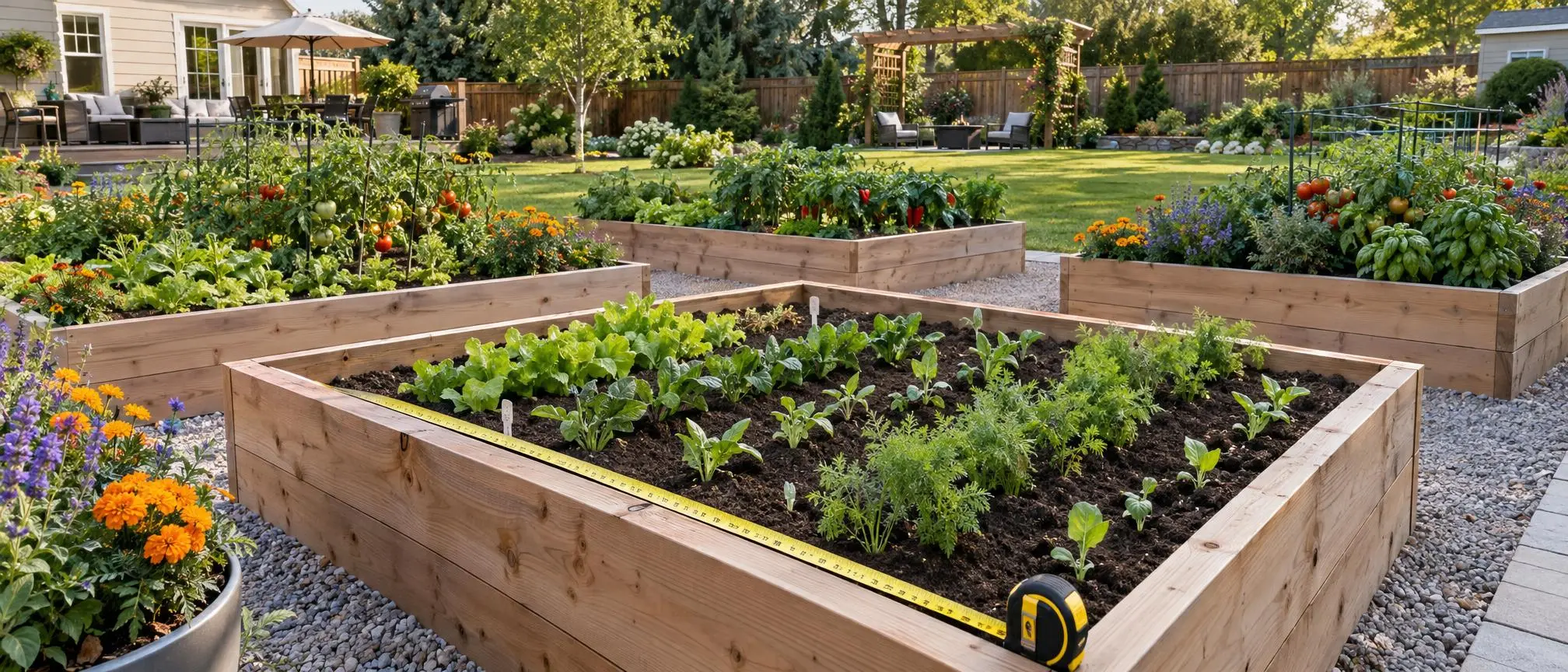

Using a soil calculator is essential when you want to figure out how much soil you need for a new garden, raised bed, or lawn. The thought of creating a new garden seems straightforward, however, there is one major question you will have to answer before starting your project: how much soil do you need? If you intend to fill a raised garden bed, create a vegetable garden, level a lawn, or build a flower garden, it is important to estimate correctly how much soil you will require.
Too much soil will result in an incomplete garden bed and may limit root growth. A poor estimate will create unused product and cause extra work.
A soil calculator is a great way to help with your gardening projects because it takes the guess work out of determining the amount of soil required for each of your gardening areas. It allows you to convert from simple measurements to the approximate total volume of soil that will be needed. This is a much better alternative than trying to guess how many cubic feet or cubic yards of soil you need for your gardening projects.
The steps to take when taking measurements are surprisingly simple. Most times, all you have to do is take three measurements: the length, the width, and the depth.
This complete guide will provide you with all of the necessary information about using a soil calculator, understanding soil measurement units, estimating the amount of soil required based on various garden designs and avoiding some of the most common errors made when calculating soil amounts.
In addition to this you will be provided with formulas, conversion tables, worked examples and answers to many of your questions.
What Is a Soil Calculator?
A soil calculator is a measuring device that estimates how much soil will be needed to fill or cover a given space.
The process calculates the amount of area a soil needs to cover. The area of a rectangle can be calculated by using the product of the length, width, and depth once all measurements have been converted to the same unit.
You can measure the total volume in cubic feet, cubic yards, cubic meters, or liters.
Suppose you have a raised garden bed that is 8 feet long, 4 feet wide and 1 foot high.
Multiplying these dimensions gives:
8 × 4 × 1 = 32 cubic feet.
This means the raised bed has a theoretical capacity of 32 cubic feet.
Using a soil calculator will allow you to do similar calculations on multiple gardens of different sizes without having to convert each unit of measurement by hand.
It’s essential to recognize that a volume calculation will provide an estimate of how much area you have. The calculation won’t provide an automatic reading on what type of soil you’re working with, how many nutrients it contains, or whether your garden can support the specific types of plants you plan to use.
Why Accurate Soil Calculations Matter
Estimates of the amount of soil required will help in planning processes and avoid unnecessary errors.
When you are building several raised beds, have an unusually shaped area to plant, or want to make sure your project has a uniform layer of soil, a soil calculator can be very helpful.
Better garden preparation
Knowing about how much soil you will need for your garden, allows you to get ready for planting in that space.
Appropriate soil depth
Plants have different root space requirements, so calculating the volume needed at the right depth helps you plan effectively.
Less material waste
If you over estimate how much soil you will have, then you may end up with too much material for your garden.
Consistent coverage
Calculating how much topsoil to use on a lawn or garden helps ensure a relatively consistent layer.
Easier project organization
By taking accurate measurements, you can break down a large project into smaller parts, and then make estimates for each of those parts.
In the end, the goal of a soil calculator is to help gardeners determine how much soil they need by making it easier to measure, predict and control.
How to Use a Soil Calculator Step by Step
Using a soil calculator generally involves four simple steps.
Step 1: Measure the length
Measure the longest side of your garden bed or planting area.
The measurement system used for gardens throughout the U.S. is generally based on feet.
If an area has an irregular or curved boundary, you can break it down into smaller, simpler parts that are easier to measure.
Step 2: Measure the width
Measure the distance across the planting area.
To obtain an accurate measurement of the width of a rectangular garden, it is necessary to make sure that you are measuring at right angles to the length of the garden.
When figuring out how much soil you’ll need to fill your raised bed, use internal measurements. The width and length of your raised bed will be smaller than its actual outside dimensions since there are walls on either side that take up room.
Step 3: Determine the soil depth
Depth describes how thick the new soil layer will be.
For example, a new thin top dressing applied to an existing lawn requires a different type of math than a new empty raised bed requiring soil.
Record the depth in inches or feet.
Step 4: Calculate the volume
In order to determine how much soil you will need, enter your measurements into a soil calculator or use the correct manual formula.
Review the units before accepting the result. If you use feet and inches to measure the depth of an object, convert it to feet prior to multiplying.
The final figure estimates how much liquid you need to fill the measured space.
Soil Calculator Formula Explained
The ability to understand how a soil calculator works will allow you to double check the accuracy of the results of the calculation and to make calculations on your own regarding the amount of soil required for your project.
For a rectangular area, the basic formula is:
Volume = Length × Width × Depth
All three measurements must use the same unit.
Calculate soil in cubic feet
When length, width, and depth are measured in feet:
Cubic feet = Length (ft) × Width (ft) × Depth (ft)
Suppose a garden bed measures:
- Length: 10 feet
- Width: 5 feet
- Depth: 1 foot
The calculation is:
10 × 5 × 1 = 50 cubic feet.
The bed needs about 50 cubic feet of soil to fill up the area you measured.
Calculate soil in cubic yards
One cubic yard equals 27 cubic feet.
Therefore:
Cubic yards = Cubic feet ÷ 27
For the same garden:
50 ÷ 27 = 1.85 cubic yards.
A soil calculator commonly performs this conversion automatically.
Calculate with depth measured in inches
Garden soil depth is frequently expressed in inches.
Use this formula:
Cubic feet = Length (ft) × Width (ft) × Depth (in) ÷ 12
For cubic yards:
Cubic yards = Length (ft) × Width (ft) × Depth (in) ÷ 324
The equations above can be used for raised beds, lawns, garden borders and other types of rectangular areas.
Soil Measurement Conversion Chart
A soil calculator may display results using different units depending on the intended project.
Understanding these conversions helps you interpret the numbers.
| Measurement | Equivalent |
| 1 foot | 12 inches |
| 1 cubic foot | 1,728 cubic inches |
| 1 cubic yard | 27 cubic feet |
| 1 cubic foot | Approximately 28.32 liters |
| 1 cubic yard | Approximately 764.55 liters |
| 1 cubic meter | Approximately 35.31 cubic feet |
| 1 cubic meter | Approximately 1.31 cubic yards |
| 1 cubic meter | 1,000 liters |
These are volume conversions, not weight conversions.
For instance, one cubic yard of wet soil may weigh significantly more than one cubic yard of dry soil, even though both occupy the same volume.
How Much Soil Do I Need for a Raised Garden Bed?
The reason most people use a soil calculator when they want to grow plants in a raised bed is because that is where they plan on planting.
The benefit of using raised beds is that they provide a defined growing area for plants which allows for greater control over the amount of soil used, as well as managing the environment around the plants.
The required amount of soil for your garden will depend upon both the dimensions inside the bed and how high you intend to fill the bed.
Example: 4 × 8 raised garden bed
Consider a raised bed with these measurements:
- Length: 8 feet
- Width: 4 feet
- Soil depth: 12 inches
First, convert the depth to feet:
12 ÷ 12 = 1 foot.
Then multiply:
8 × 4 × 1 = 32 cubic feet.
Convert to cubic yards:
32 ÷ 27 = 1.19 cubic yards.
The required amount of soil for this project is estimated at 32 cubic feet (approximately 1.19 cubic yards).
This calculation assumes the entire measured depth is filled with soil.
If there is soil on top of the bed, only measure the unfilled portion of the bed.
Raised bed soil volume chart
The following is a list of theoretical soil quantities for typical rectangular planting beds that are filled with 12 inches of soil.
| Bed dimensions | Cubic feet | Cubic yards |
| 2 × 4 feet | 8 | 0.30 |
| 3 × 4 feet | 12 | 0.44 |
| 4 × 4 feet | 16 | 0.59 |
| 4 × 6 feet | 24 | 0.89 |
| 4 × 8 feet | 32 | 1.19 |
| 4 × 10 feet | 40 | 1.48 |
| 4 × 12 feet | 48 | 1.78 |
| 6 × 8 feet | 48 | 1.78 |
For beds with different depths, use a soil calculator to adjust the estimates rather than assuming every bed requires the same amount.
How Deep Should Soil Be in a Raised Garden Bed?
Because the root system of a plant needs enough space to grow, take in water, and get nutrients, the depth of your soil is important.
A soil calculator estimates the volume of soil needed, but you must decide how deep to place it.
Different plants have different rooting patterns.
Leafy green plants with short roots are able to grow well in shallow soil. However, many larger vegetables and root vegetables do best when they have more room to develop their root systems.
Soil beneath a raised-bed, open-bottom system will add to the overall depth of the plant’s roots if the soil is healthy, available for the roots to grow into, and does not have excessive compaction.
General soil depth reference
| Planting situation | General depth consideration |
| Shallow-rooted greens | Around 6–8 inches may support some varieties |
| Many herbs | Often benefit from 8–12 inches or more |
| General vegetable beds | Approximately 12 inches is a useful starting point |
| Larger vegetable plants | Often benefit from 12–18 inches or greater rooting depth |
| Root vegetables | Depth depends on the crop and mature root size |
| Established beds | Add only the volume needed to reach the desired level |
These are planning guidelines, not universal requirements.
Take into account the type of plant you are growing, the composition of the soil beneath your planting bed, the amount of drainage available to the plants, and the environmental factors that will affect the growth of the plants.
If you have an existing growing soil directly below your raised bed then you may not necessarily need to fill the entire depth of the raised bed with fresh soil.
Soil Calculator for Lawns and Grass Areas
A soil calculator can also help estimate topsoil required for a lawn.
This calculation is similar to a raised garden, however the additional layer of soil will be significantly less than in a raised garden.
For example, suppose a lawn measures:
- Length: 30 feet
- Width: 20 feet
- Desired soil layer: 2 inches
First, calculate the area:
30 × 20 = 600 square feet.
Then calculate volume:
600 × 2 ÷ 12 = 100 cubic feet.
Convert to cubic yards:
100 ÷ 27 = 3.70 cubic yards.
This is how much volume would be required if we were going to place a uniform 2-inch thick layer of material on top of the 600 square feet of land.
However, actual lawn requirements depend on the project.
The depth of the soil used for applying a thin layer of topsoil over the surface of your lawn, correcting areas that are not level, and creating an entirely new lawn can all vary.
When applying soil over top of existing turf, too much application of the new material can cause damage to the existing turf by covering up the growth areas of the existing turf.
Rather than using the same depth on each job, select the depth based upon the current state of the lawn.
Soil Calculator for Flower Beds
Flower beds vary considerably in size, shape, and planting depth.
A soil calculator can assist with estimating amounts needed for newly established beds and existing areas in need of soil enhancement.
Suppose a flower bed measures 12 feet long and 3 feet wide.
You plan to add a layer of soil approximately 4 inches deep.
The formula is:
12 × 3 × 4 ÷ 12 = 12 cubic feet.
In cubic yards:
12 ÷ 27 = 0.44 cubic yards.
This estimate is useful when preparing a new planting area.
On the other hand, placing additional soil over an area of existing soil is different than mixing organic material with the existing soil.
The depth of the added amendment will vary depending upon what is being improved in an existing soil, as well as the gardening goal(s) of the gardener.
Avoid unnecessarily burying the crowns or stems of existing plants.
Soil Calculator for Circular Garden Beds
Not every garden is rectangular.
A soil calculator designed for circular areas uses a different formula.
First, calculate the surface area of the circle:
Area = π × Radius²
Then multiply by the soil depth:
Volume = π × Radius² × Depth
The radius is half the diameter.
Circular garden example
Suppose a circular flower bed has:
- Diameter: 6 feet
- Radius: 3 feet
- Soil depth: 6 inches
Convert the depth:
6 ÷ 12 = 0.5 feet.
Then calculate:
3.1416 × 3² × 0.5 = 14.14 cubic feet.
Convert into cubic yards:
14.14 ÷ 27 = 0.52 cubic yards.
The result is approximately 14.14 cubic feet.
This formula can be used to calculate how much soil you will need for a circular planting area that surrounds a small landscape feature, if you want all parts of the area being measured to have the same depth of soil.
Soil Calculator for Irregular Garden Shapes
Irregular garden layouts require a little more planning.
Instead of making an estimate for the whole area by creating a single rectangular shape, break the area down into smaller portions that have defined shapes and can be measured.
For example, an L-shaped garden can often be divided into two rectangles.
Calculate the soil volume of each rectangle independently.
Then add the results together.
Total volume = Section A + Section B + Section C
For curves, dividing into smaller subsections can yield a better representation of the curve than a single large section (rectangle).
Another way to calculate this is to determine the complete surface area initially, then multiply that value by the desired depth.
A soil calculator is especially useful if you are combining multiple planting beds.
Be careful not to count overlapping sections twice.
Measure soil depth on very uneven ground in several spots. Soil amounts vary throughout the area.
How Much Soil Is Needed for Different Depths?
Depth has a direct effect on the amount of soil required.
The required volume is doubled if you double the depth of an object, as long as its surface area remains the same.
This chart illustrates the amount of cubic feet/yards required to cover 100 square feet with various amounts of depth.
| Soil depth | Cubic feet | Cubic yards |
| 1 inch | 8.33 | 0.31 |
| 2 inches | 16.67 | 0.62 |
| 3 inches | 25.00 | 0.93 |
| 4 inches | 33.33 | 1.23 |
| 6 inches | 50.00 | 1.85 |
| 8 inches | 66.67 | 2.47 |
| 12 inches | 100.00 | 3.70 |
These estimates assume a flat surface and consistent soil thickness.
A soil calculator can accommodate various area sizes and depths; however, a soil calculator cannot make independent decisions on the appropriate depth for your plants.
The decision on what type of plant to grow in your garden depends upon how well the current soil is suited for plant growth, how much room the roots need, how quickly water will drain from the area, and what you plan to do with the space.
How to Calculate Soil for Multiple Garden Beds
If you are working with multiple raised beds, make sure to determine the size of each bed individually, as long as they have different measurements.
Suppose your garden contains:
- Two beds measuring 4 × 8 feet, each 12 inches deep.
- One bed measuring 3 × 6 feet, 12 inches deep.
Each 4 × 8 bed requires:
4 × 8 × 1 = 32 cubic feet.
Two beds require:
32 × 2 = 64 cubic feet.
The smaller bed requires:
3 × 6 × 1 = 18 cubic feet.
Add the volumes:
64 + 18 = 82 cubic feet.
Convert to cubic yards:
82 ÷ 27 = 3.04 cubic yards.
Your total theoretical requirement is approximately 3.04 cubic yards.
A soil calculator supporting multiple beds can make the process easier to complete, particularly if each bed has a varying depth.
Should You Add Extra Soil for Settling?
After you fill a hole with soil, it will often settle. That’s because the soil is loose and has many empty pockets of air. When you water the soil, those empty spaces fill in. Over time, as the soil gets packed down by nature, those same empty spaces become smaller.
The final surface level can therefore be lower than what it was when you first filled it.
Some gardeners include a small allowance when estimating soil volume.
For example, adding 10% to a calculated volume of 32 cubic feet gives:
32 × 1.10 = 35.2 cubic feet.
However, 10% is only a planning allowance, not a universal settling rate.
The actual amount of settlement will depend upon the soil’s texture, its moisture content, organic matter present in the soil, and the level of compaction that was achieved when the soil was deposited.
If there is a raised bed that has been compacted by previous use, adding an estimated amount of new soil will likely result in too much soil being added.
Use the result from the soil calculator as the baseline and then make adjustments appropriately depending upon what is happening in reality.
Do not over-compact the soil around your newly planted plants, just to keep it from settling. Over-compacting the soil may cause limits to how well the roots grow into the surrounding soil as well as limits on how quickly water can drain away.
How Many Cubic Feet Are in a Cubic Yard of Soil?
One cubic yard contains exactly 27 cubic feet.
This conversion is fundamental to understanding any soil calculator result.
A cubic yard is a three-dimensional space measuring:
3 feet × 3 feet × 3 feet.
Multiplying these dimensions gives:
3 × 3 × 3 = 27 cubic feet.
To convert cubic feet into cubic yards, divide by 27.
To convert cubic yards into cubic feet, multiply by 27.
For example:
27 cubic feet = 1 cubic yard.
54 cubic feet = 2 cubic yards.
81 cubic feet = 3 cubic yards.
108 cubic feet = 4 cubic yards.
Keep in mind that cubic yards determine the amount of space occupied (volume), whereas square yards determine the amount of land/surface area.
Confusing these two measurements can lead to major calculation errors.
Soil Volume vs. Soil Weight: What Is the Difference?
A soil calculator usually estimates volume rather than weight.
Volume represents the space occupied by soil.
Weight depends on the volume together with the soil’s bulk density.
Soil’s density is determined by how much water is present in it, what types of minerals are found in it, how much organic material has been added to it, and how much it has been compacted.
In other words, if you had two containers of the exact same size that were each filled with a different type of soil, those two containers could weigh significantly different amounts.
Wet soil may also be substantially heavier than the same material when dry.
The general relationship is:
Weight = Volume × Bulk Density
To find an estimate of the weight (in pounds) of a material with its density given in pounds per cubic foot, you can take the value of the density and multiply it by the total volume of that material (in cubic feet).
Do not assume that every cubic yard of soil has the same weight.
When weight is an issue for a raised structure (such as a balcony, roof top, or elevated planter), get the actual weight of materials being used, and determine how much weight the support system can hold.
Common Soil Calculation Mistakes to Avoid
When you provide inaccurate measurements into your soil calculator, even though the calculator itself is reliable, you will still get a wrong answer.
Mixing feet and inches
If you have the measurements of length and width in feet, but the measurement of depth in inches, make sure to change the unit of measurement of the depth prior to calculating.
Measuring outside dimensions
For enclosed garden beds, use the internal length and width.
Forgetting the existing soil level
Measure only the area of the partially-filled bed which requires additional soil.
Confusing area with volume
Square feet describe surface area. Cubic feet describe three-dimensional space.
Ignoring uneven ground
Sloped or uneven garden areas may require multiple depth measurements.
Assuming all soil settles equally
Different soil materials respond differently to watering and compaction.
Choosing an unsuitable soil depth
A mathematically correct result is not necessarily horticulturally appropriate.
Avoid making errors by taking precise measurements and verifying the units prior to doing calculations.
How to Improve Soil Calculation Accuracy
The most useful soil calculator results begin with accurate measurements.
First, determine the actual planting area before making an educated guess about how much room you have for planting.
Second, determine if the project will have no bed (empty), an added layer of soil, or a complete replacement of current materials.
Third, use a consistent system of measurement throughout the calculation.
Fourth, divide complex garden shapes into manageable sections.
Fifth, think about if the final amount may be altered by soil settling or by an uneven surface.
At last, review the figures by hand with an elementary formula if you feel the output is excessively large or small.
A small measurement error can become significant across a large area.
An increase in the depth of 3 inches to 4 inches would result in an increase in the amount of volume needed by about 33.3%.
Accurate depth measurements are therefore particularly important.
Frequently Asked Questions About Soil Calculator
How do I calculate how much soil I need?
To determine how much topsoil you need to purchase for your garden, measure the dimensions (length, width) of the area where you plan to install the topsoil. Also measure the required depth of topsoil that you want to apply to the area. Convert all three measurements into feet and multiply them together to calculate the volume in cubic feet. Then divide the total number of cubic feet by 27 to convert it to cubic yards. You can use an online soil calculator to do these calculations for you.
How much soil do I need for a 4 × 8 raised bed?
For a 4 x 8-foot raised garden bed that will be 12 inches deep, the total volume of soil needed would be 32 cubic feet, which equals about 1.19 cubic yards. When you are filling your garden bed, if it is only partially filled then you should only determine how much empty space remains within the bed.
How many cubic feet of soil are in one cubic yard?
Each cubic yard has exactly 27 cubic feet. Soil types and/or moisture levels will have no effect on this as it is a standard volumetric unit of measure conversion.
Can I use a soil calculator for a lawn?
Yes. You can use a soil calculator to determine how much topsoil is needed to create a layer of topsoil over your lawn of a specific thickness. To do this you will need to measure the size of your lawn, select an appropriate thickness of topsoil, and remember that there are significant differences between light topdressing of your existing lawn, and establishing a new lawn.
How much soil is needed for 100 square feet?
In terms of the depth of the covering, for every 100 sq ft that is covered in a single-inch layer, there will be about 8.33 cu ft needed. For 3 inches deep, this quantity is reduced to 25 cu ft. If you need to cover at least 6 inches, then the required quantity will increase to 50 cu ft.
How do I calculate soil for a circular garden?
Determine the radius by dividing the diameter of the hole in half. Use pi x (radius squared) to calculate the area of the circle; then multiply the area of the circle by the depth. Be certain that all measurements are expressed in the same unit.
Is one cubic yard the same as one square yard?
No. The difference between a cubic yard and a square yard is that one is used to measure volume, while the other is used to measure area. A square yard has nine square feet, and a cubic yard has 27 cubic feet.
Should I add extra soil to my calculation?
An additional allowance may be useful when you are dealing with a settlement issue, or if you expect a small measurement error. However, how much you allow will depend on what type of soil you are working with and the specific circumstances surrounding your project. There is no need to make the same percentage allowance for every garden.
Does soil weight affect the calculator result?
The use of a volume-based soil calculator is independent of soil weight. Weight however is critical to calculate the structural load and to convert volume to tonnage. To do so requires accurate data on soil density.
What is the easiest soil calculation formula?
For rectangular garden areas, the easiest formula is:
Cubic feet = Length (ft) × Width (ft) × Depth (in) ÷ 12
To convert the result into cubic yards, divide by 27.
Final Thoughts: Calculate Your Garden Soil With Confidence
Estimating soil requirements does not have to be complicated.
Regardless of what type of gardening project you are undertaking (whether it is creating a vegetable garden, filling your raised bed, enhancing a flower border or adding top soil to your lawn) with the right measurement, all aspects of the job will be simpler.
A soil calculator is a useful tool that translates length, width and depth into relevant volume estimates.
The primary steps include measuring the growth zone accurately, selecting an adequate amount of topsoil, maintaining a uniform unit system when calculating, and accounting for the presence of existing soils or uneven terrain.
Remember, the calculated volume is what you will use to determine how much space you have available to put in. This does not mean that the type of soil you select will necessarily work with your plant species.
Appropriate drainage, aeration, biological activity, and nutrient balance are required for a healthy soil.
By combining accurate measurements with proper gardening practices, you will be able to establish an ideal environment for your plants to develop strong root systems and ultimately achieve maximum growth potential.
Use the soil calculator to make sure you have enough soil for your next gardening project, and make those hard-to-figure-out estimates simple and practical.